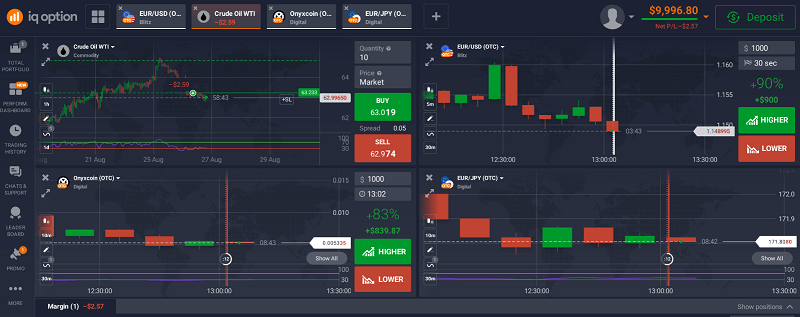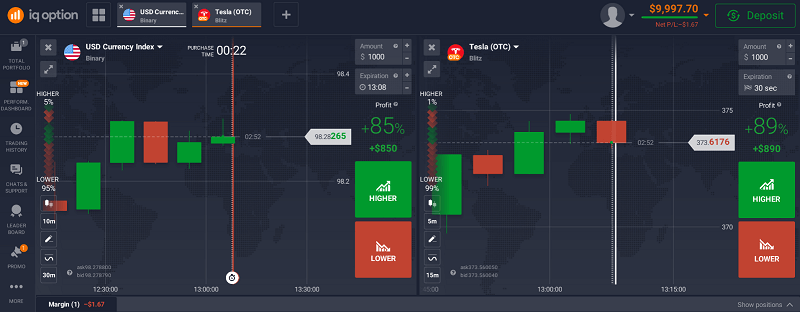
Quotex Compounding Strategy: How to Grow Your Account Fast
I still recall the first time I encountered the term “compounding” in trading. It sounded like some complicated Wall Street tactic. But over the years, it became my secret weapon. Especially on Quotex, where short-term trades can deliver quick returns, compounding helped me grow small accounts faster than I thought possible.
This guide is everything I wish someone had told me back when I started. I’ll walk you through what compounding really means in binary options, how to apply it on Quotex without blowing your account, and show you a real case study of how I scaled up $50 into $2,100 in just a few weeks. No hype, just what works.
Additionally, a free calculator is available to help you plan your journey.
If you’re new to Quotex, sign up using my link and start with a free $10 demo account or a real one with a minimum deposit of just $10. Start trading on Quotex now.
What Is Compounding in Quotex Trading?
Compounding in Quotex is simply reinvesting your profits to grow your trading capital. Instead of withdrawing every little win, you add it to your next trade. It’s like stacking your gains.
Let’s say you start with $10 and make a 90% win on a trade. That’s $19 now. If you reinvest the $19 and win again, you make $36.10. Do this consistently, and your account will snowball quickly.
But here’s the catch: doing it unquestioningly leads to disaster. Compounding works only if you:
Have a consistent, high-probability strategy
Control your emotions
Stick to a fixed plan and know when to stop
Why Compounding Works Best on Quotex
Unlike forex or stock trading, Quotex gives fixed payouts. You know your reward and risk before you click “Trade.” That’s perfect for compounding because:
Trade durations are short (60s to 5 mins)
You can reinvest multiple times a day
You don’t need 100 trades to see growth
Losses are limited to your trade amount
It’s basically a fast lane for disciplined traders. But that’s the key word, “disciplined”.
My First Attempt at Quotex Compounding (And What I Got Wrong)
Back in early 2020, I deposited $100 into Quotex. My plan? Compound 100% of profits every single trade. No breaks. No rest. Just full send.
I turned $100 into $400 in one session. Felt like a genius. The next day, I lost it all on trade number one.
I didn’t understand risk tiers, didn’t know when to stop, and I was just chasing numbers. That failure taught me something huge:
“The goal isn’t to get rich overnight. The goal is to grow predictably.”
So I went back to the drawing board. Started slow. Introduced rules. Created a compounding table. And it changed everything.
The Smart Compounding Method I Use Now
Here’s the method that helped me scale consistently.
Step 1: Start with a Small Account
I usually begin with $50. Not because I’m broke, but because it removes fear. If I lose it, I walk away. No guilt. No revenge trading.
Step 2: Use a Tiered Compounding Plan
Instead of compounding 100% every time, I break it into tiers.
Tier 1: Trade with 10% of capital (e.g. $5)
Tier 2: Reinvest 50% of profits into the next trade
Tier 3: Once the account grows 100%, withdraw 25% and restart
This method reduces risk while keeping momentum.
Step 3: Only Compound After 2-3 Confirmed Wins
This one’s underrated. I don’t start compounding unless I’ve had two wins using the same strategy in real-time. It builds confidence.
Step 4: Stop After 3-4 Compound Trades
You don’t need to compound endlessly. My rule: stack three successful trades, then pause. Withdraw or reset.
That pause saved me from countless wipeouts.
Real Case Study: $50 to $2,100 in 17 Trading Sessions
Here’s how one of my best runs went.
Day 1: $50 → $72 (2 trades)
Day 2: $72 → $105
Day 3: No trade (market too choppy)
Day 4: $105 → $160
Day 5: $160 → $240
Day 6: $240 → $360 (cashed out $60)
Day 7: $300 → $450
Day 8: Loss – back to $300 (reset compounding)
Day 9-15: Gradual build from $300 → $1,050
Day 16-17: Two high-conviction trades ($500 and $750)
Final Balance: $2,100 (with $300 withdrawn earlier)
This wasn’t luck. It was structured. I treated it like a business.
Want to try the same structure? Use the Quotex Compounding Calculator to plan your goals. Set your start amount, daily return, and compounding frequency.
How to Manage Risks While Compounding
Let’s address the elephant in the room: Compounding is risky if done wrong. Here’s how I control it:
Use 1-2 trusted strategies only (don’t jump between setups)
Trade during optimal hours (avoid news and low-volume zones)
Set daily stop loss (mine is 30% of current balance)
Withdraw weekly (or when you hit a milestone)
Don’t trade under pressure (skip days if feeling off)
Also, remember that no compounding plan works if your win rate is below 60%. Focus on building consistency first. Then compound.
Best Time to Use Quotex Compounding
Timing is everything. I’ve found the best windows for compounding on Quotex are:
Morning Session (9 AM to 11 AM GMT+5) – European overlaps, solid volatility
Evening Session (7 PM to 10 PM GMT+5) – US session winds down, cleaner trends
Avoid weekends or OTC unless you’re testing.
I also avoid Mondays (due to unpredictable trends) and Fridays (the market cools down after midday).
Common Mistakes I See Traders Make
These killed my earlier attempts, and I still see others doing them:
Over-trading after a loss to recover
Compounding without a win streak
No written plan or table
Ignoring payout % – if it drops below 70%, skip the trade
Using full balance each time – this is gambling, not compounding
If you avoid these, you’re already ahead of 90% of traders.
FAQs About Quotex Compounding Strategy
Is compounding more effective than fixed-stake trading on Quotex?
Yes, if you have a consistent win rate and a strict plan. A fixed stake is safer, but compounding yields exponential growth. You can even mix both methods.
How many trades should I compound per day?
Ideally 2–4 max. After that, market conditions change, and psychology gets fragile. Take your profit and reset.
What happens if I lose a compound trade?
You lose only the amount risked on that trade, not the whole chain. That’s why we use tiers and stop points. Never compound all-in.
Can I compound on a demo before trying real money?
Absolutely. You should test your compounding rules on the demo for at least a week. Quotex gives you a free demo account to practice.
What’s the best Quotex strategy to pair with compounding?
I employ a 1-minute trend-following strategy that utilises support and resistance levels, as well as RSI confirmation. Look for clean setups, no noise. Avoid indicators that lag.
Final Thoughts: Compounding Is a Tool, Not a Shortcut
If there’s one thing I’ve learned, it’s this: compounding multiplies your strengths and your weaknesses. If you’re consistent and disciplined, it works like magic. But if you’re emotional and impulsive, it burns fast.
Start small. Use a written plan. Withdraw profits often. And always trade when your mind is clear.
Quotex gives us a powerful platform. Fixed risk, fast trades, and flexible timing make it ideal for compounding. But only if you respect the process.
You can deposit as low as $10, test your strategy on a demo, and use the compounding calculator to project your goals.
Just remember, slow growth is still growth. Compounding is your engine. Discipline is the fuel. Let’s grow smart.
Quotex Account Types: Which One Is Best for You?
When I first started trading on Quotex, I was unsure which account type to choose. The platform offered different tiers, each with its benefits and requirements. I didn’t know whether to stick with the basic option or jump straight into the VIP program. After spending several months trading across various account levels, I’ve learned exactly what each tier offers and when to upgrade.
Let me share everything I’ve discovered about Quotex account types so you can make the right choice for your trading journey.
Start trading with Quotex today – just $10 minimum deposit!
Understanding Quotex Account Structure
Quotex operates with a straightforward account system that’s designed to grow with your trading experience. Unlike some brokers that overwhelm you with countless options, Quotex keeps things simple with three main account types that cater to different trading styles and capital levels.
The beauty of Quotex’s system is that every trader starts with the same basic access. As you deposit more funds and trade more actively, additional benefits unlock automatically. This means you don’t have to worry about choosing the wrong account type from the start.
Quick Account Comparison
Feature
Standard
Pro
VIP
Minimum Deposit
$10
$1,000
$5,000-$10,000
Payout Bonus
Base rates
+2%
+4%
Withdrawal Speed
1-3 days
24-48 hours
24 hours
Customer Support
Standard
Priority
Dedicated manager
Exclusive Bonuses
Basic
Enhanced
Premium
The Standard Account: Your Starting Point
The Standard account is where most traders begin their Quotex journey. When I opened my first account, I was amazed at the extensive functionality available from the start.
With the Standard account, you gain access to all the basic trading features that most traders require. The minimum deposit is remarkably low at just $10, making it accessible to virtually anyone who wants to try binary options trading. This low barrier to entry was one of the reasons I chose Quotex over other platforms.
Key Features
Minimum deposit: $10
Payouts up to 95%
Access to 400+ trading instruments
Basic customer support
Standard withdrawal processing
The Standard account offers payouts of up to 95% on successful trades, depending on the asset and market conditions. Although this may seem lower than those of premium accounts, it remains competitive in the binary options space. You gain access to over 400 trading instruments, including forex pairs, cryptocurrencies, commodities, and stock indices.
One thing that impressed me was the quality of the trading platform itself. You get the same advanced charting tools, technical indicators, and market analysis features that VIP members use. The only difference is in the additional perks and higher profit margins that come with upgrading.
Who It’s For
The Standard account is perfect for complete beginners who want to learn the platform without significant financial risk. It’s also suitable for casual traders who make occasional trades rather than day trading. The basic features are more than sufficient for occasional trading, and the lower deposit requirement keeps your risk manageable.
The Pro Account: The Middle Ground
The Pro account bridges the gap between basic and premium trading. After trading for a few months with the Standard account, I decided to upgrade to Pro, and the difference was immediately noticeable.
To qualify for the Pro account, you need to maintain a higher account balance, typically around $1,000 or more. This requirement ensures that Pro account holders are more serious about their trading and have sufficient capital to take advantage of the enhanced features.
Key Features
Minimum balance: $1,000
An additional 2% payout on all assets
Faster withdrawals (24-48 hours)
Exclusive promotional offers
Priority customer support
The most significant benefit of the Pro account is the increased payout percentage. This account offers an additional 2% payout on all available assets. Although this may not sound like a substantial amount, over time, those extra percentage points add up to significant profits.
Pro account holders also get access to exclusive promotional offers and bonuses that aren’t available to Standard account users. During my time with the Pro account, I received several bonus offers that helped boost my trading capital. These bonuses often come with reasonable terms and conditions, making them genuinely useful.
Qualification Requirements
The upgrade process is straightforward. You simply need to maintain a balance of $1,000 or more, and the platform automatically recognises your eligibility. You’ll receive a notification when the upgrade takes effect, and the enhanced benefits will activate immediately, with no additional fees required.
The VIP Account: Maximum Benefits
The VIP account is designed for serious traders who demand the best. The decision to upgrade to VIP status was a significant one for me. The substantial minimum deposit requirement means this account is only suitable for traders with considerable capital or those who have built up their account balance over time.
However, the benefits justify the investment for active traders. VIP account holders receive the highest payout percentages on the platform, with up to 4% extra profitability on all instruments. This additional profit margin makes a huge difference when you’re making multiple trades per day.
Key Features
Minimum deposit: $5,000-$10,000
An additional 4% payout on all instruments
Dedicated account manager
Priority support (24-hour response)
Exclusive market analysis and signals
One of the standout features of the VIP account is the dedicated account manager. Having a personal contact who understands your trading style and can provide valuable market insights is invaluable. My account manager regularly shares market analysis and trading opportunities that I might have otherwise missed.
VIP members also get priority customer support with faster response times and access to exclusive educational resources. The platform provides advanced trading signals and market analysis that aren’t available to lower-tier accounts.
VIP Requirements
The first step towards becoming a Quotex VIP is depositing a qualifying amount. Based on my research and experience, the full VIP benefits typically require maintaining a balance of $5,000 to $10,000 or more. The exact requirements may vary based on your trading activity, deposit history, and overall relationship with the platform.
Ready to maximize your profits? Sign up for a VIP account today!
Account Upgrade Process
Standard to Pro Upgrade
Deposit and maintain $1,000+ balance
Automatic upgrade notification
Immediate benefit activation
No additional verification required
Pro to VIP Upgrade
Deposit $5,000-$10,000 minimum
Demonstrate consistent trading activity
Platform review of trading history
Personal account manager assignment
Important Notes
Upgrades are typically permanent
Downgrades occur if the balance drops below requirements
No fees for upgrading accounts
Benefits activate immediately upon upgrade
Detailed Benefits Comparison
Trading Returns
Standard: Base payout rates up to 95%
Pro: An Additional 2% across all assets
VIP: Up to 4% extra profitability
Bonuses and Promotions
Standard: Basic welcome bonuses (30% on $100+ deposits)
Choosing the correct account type depends on several factors, and I’ve seen traders make mistakes by either starting too high or staying too low for too long.
For Beginners: Standard Account
If you’re new to binary options trading, the Standard account is ideal. The $10 minimum deposit allows you to test the waters without incurring significant financial risk. You can learn the platform, develop your trading strategy, and build confidence before committing more capital. The Standard account is also suitable for casual traders who make occasional trades rather than day trading.
For Intermediate Traders: Pro Account
Consider upgrading to Pro if you’re trading regularly and have built up your account balance to around $1,000 or more. The additional 2% payout increase becomes meaningful when you’re making multiple trades per week. The faster withdrawals and exclusive bonuses also provide tangible benefits. The Pro account is ideal for intermediate traders who have developed a consistent trading strategy.
For Advanced Traders: VIP Account
The VIP account is worth considering if you’re a serious trader with substantial capital and trade like a pro. The 4% additional payout can generate significant extra profits for high-volume traders. The dedicated account manager and priority support become particularly valuable when managing larger positions.
However, don’t rush into VIP status just for the prestige. The substantial minimum deposit requirement means you need to be comfortable with that level of risk. Only upgrade to VIP if you have the experience and capital to justify the investment.
Key Decision Factors
When making your choice, consider your available trading capital, trading frequency, experience level, risk tolerance, and profit goals. The most crucial factor is choosing an account type that aligns with your current situation and trading objectives.
Common Misconceptions
Myth 1: Different Trading Instruments
Reality: All account types access the same 400+ trading assets. Only payouts and services differ.
Myth 2: Choose Account Type at Signup
Reality: Everyone starts with Standard. Upgrades happen automatically based on balance.
Reality: All accounts get professional support. VIP accounts get faster response times, not better quality.
Maximizing Your Account Benefits
Based on my experience across different account tiers, here are some strategies to get the most value from your Quotex account.
For All Account Types
Begin with the Standard account and focus on learning rather than earning. Utilise the low deposit requirement to your advantage by testing various trading strategies without risking significant capital. The primary goal at this stage is education and skill development.
Take advantage of the demo account, regardless of your account type. The $10,000 demo balance allows you to practice new strategies without risking real money. I still use the demo account to test new approaches before implementing them with real funds.
Strategic Upgrade Timing
Monitor your account balance and trading frequency to determine the optimal time to upgrade. Don’t upgrade simply because you can. Ensure that the additional benefits justify the higher capital requirements.
Utilize the educational resources available to your account type. Even Standard accounts have access to valuable learning materials that can improve your trading skills. VIP accounts should take full advantage of the exclusive market analysis and trading signals.
Getting Maximum Value
Build a relationship with customer support, especially if you’re a VIP member with a dedicated account manager. These relationships can provide valuable market insights and help you navigate challenging trading conditions.
Focus on developing a consistent trading strategy before upgrading to higher tiers. The additional benefits are most valuable when you have a proven approach to trading that generates regular profits.
Making the Account Type Decision
Choosing the right Quotex account type shouldn’t be taken lightly. It’s a decision that affects your trading costs, profit potential, and overall trading experience.
Consider your trading goals, available capital, and risk tolerance. If you’re exploring binary options trading for the first time, the Standard account provides everything you need to get started. The low barrier to entry makes it easy to begin your trading journey without significant financial pressure.
For traders with some experience and a proven strategy, the Pro account offers meaningful improvements in profitability and service quality. The additional 2% payout increase and faster withdrawals provide tangible benefits that justify the higher capital requirements.
Serious traders with substantial capital and a proven track record should consider the VIP account. The premium benefits, including the highest payout rates and dedicated support, can significantly enhance your trading results.
Remember that account upgrades are generally straightforward, so you can always start with a lower tier and upgrade as your trading capital and experience grow. There’s no penalty for starting small and working your way up.
The most crucial factor is choosing an account type that aligns with your current situation and trading goals. Don’t let the prestige of a higher-tier account tempt you into depositing more than you can afford to lose.
Frequently Asked Questions
What is the minimum deposit for each Quotex account type?
Standard accounts require a $10 minimum deposit. Pro accounts require a balance of $ 1,000 or more for maintenance. VIP accounts require a balance of $5,000 to $10,000, depending on trading activity.
Can I downgrade my account if I withdraw funds?
Yes, accounts automatically downgrade when the balance drops below the tier requirements. The platform usually provides advanced notice.
Do different account types have different trading platforms?
No, all accounts use identical trading platforms. Only payout percentages and support services differ.
How long does it take to upgrade to a higher account tier?
Upgrades are automatic and immediate upon meeting requirements. You’ll receive instant notification of status changes.
Are there any fees associated with account upgrades?
No upgrade fees exist. The only requirement is meeting minimum balance thresholds for higher tiers.
Can I have multiple account types simultaneously?
No, only one account type per user. However, upgrades and downgrades happen automatically based on activity.
Do VIP accounts have different withdrawal limits?
VIP accounts typically have higher withdrawal limits and faster processing, but specific limits depend on verification status.
Is customer support better for higher account tiers?
Yes, noticeable differences exist. VIP gets dedicated managers, Pro gets priority support, and Standard gets regular support.
Can I switch back to a lower account type voluntarily?
Downgrades typically happen automatically, but you can contact support for voluntary downgrades if needed.
Conclusion: Choose Your Perfect Account
Selecting the right Quotex account type sets the foundation for your trading success. Each tier serves different trader profiles and capital levels.
Standard accounts are ideal for beginners, offering a $10 minimum deposit and full platform access. Pro accounts cater to intermediate traders with balances exceeding $1,000, providing higher payouts and faster withdrawals. VIP accounts are designed for serious traders with substantial capital who demand premium benefits and dedicated support.
Success depends more on developing solid strategies and effective risk management than on account type. Start with Standard, learn the platform, and upgrade as your skills and capital grow. The flexible upgrade system allows you to progress naturally without pressure.
Remember that higher account tiers don’t guarantee profits. Focus on education, practice with demo accounts, and only invest what you can afford to lose. Choose an account type that matches your current situation, not your aspirations.
Start your trading journey today with Quotex – open your account in minutes!
Quotex Candlestick Patterns Every Trader Must Know
Let me tell you about the day I discovered the real power of candlestick patterns on Quotex. I was staring at my screen, watching my account balance drop for the third consecutive day. The charts looked like random noise to me back then. Every trade felt like a coin flip. Sound familiar?
That’s when my mentor pulled me aside and said something that changed everything: “Stop looking at prices. Start reading the story that candles tell you.” Those words transformed my trading from guesswork into a calculated strategy.
Today, I’m sharing the exact candlestick patterns that helped me turn my trading around on Quotex. These aren’t just pretty pictures on a chart. They’re the market’s way of whispering its next move to those who know how to listen.
Ready to transform your trading? Start your Quotex journey today with crystal-clear charts designed for pattern recognition. Open your free demo account now.
The Hidden Language of Candlesticks
Before we dive into the patterns, let me paint you a picture. Imagine you’re at a poker table. The other players’ facial expressions, body language, and betting patterns tell you everything you need to know about their hands. Candlesticks work the same way in trading.
Each candlestick carries four pieces of information: opening price, closing price, highest price, and lowest price. But here’s what most traders miss. The real magic happens when you combine multiple candlesticks together. That’s when the market starts telling its story.
Candlestick patterns are great indicators of the continuation or reversal of a trend, and this information can be valuable when making trading decisions. This is especially true on Quotex, where timing is everything.
Why Quotex Traders Love Candlestick Patterns
Quotex offers clean, easy-to-read charts that make candlestick analysis a breeze. Unlike some platforms where you need to squint at tiny candles, Quotex provides crystal-clear visualization. The platform’s responsive design means you can spot patterns whether you’re on your phone during lunch break or analyzing on your desktop at home.
The beauty of using candlestick patterns on Quotex lies in their simplicity. You don’t need complex indicators or expensive software. Just your eyes and the knowledge I’m about to share with you.
Pattern 1: The Hammer – Your Reversal Signal
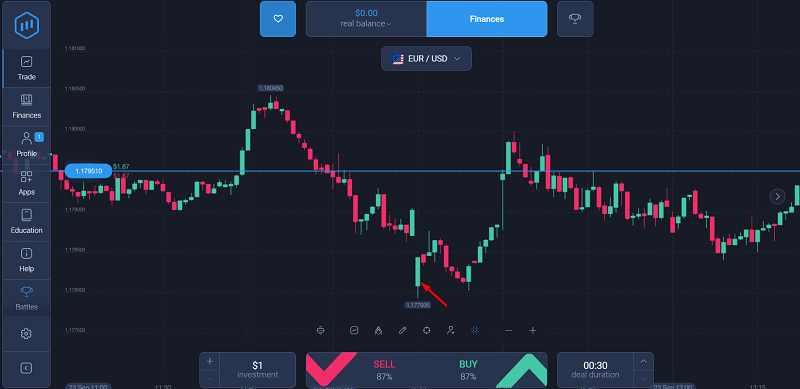
Picture this: you’re watching EUR/USD on Quotex, and it’s been falling for hours. Suddenly, you see a candle with a small body and a long lower shadow. That’s a hammer, and it’s telling you the bears are losing control.
I remember trading this pattern on gold during a particularly volatile session. The price had dropped 50 points in two hours. Then I spotted a perfect hammer forming on the 1-minute chart. The long lower shadow showed that sellers pushed prices down, but buyers stepped in and pushed it back up.
Here’s how to trade the hammer on Quotex: Wait for the hammer to form completely Look for it at the bottom of a downtrend Enter a call position on the next candle Set your expiry time to 2-3 candles ahead Use proper risk management – never risk more than 5% of your account
The hammer works because it shows a shift in sentiment. Sellers tried to push prices lower but failed. Smart money recognizes this failure and starts buying.
Pattern 2: The Hanging Man – When Bulls Get Tired
The hanging man looks identical to the hammer, but context is everything. When you see this pattern at the top of an uptrend, it’s a warning sign that buyers are exhausted.
I learned this lesson the hard way when I was trading Facebook stock on Quotex. The stock had been climbing for days, and I kept buying calls. Then I saw a hanging man form at a resistance level. I ignored it and placed another call. Big mistake. The stock dropped 3% the next day.
The hanging man tells you that during that trading period, sellers managed to push prices down significantly before buyers regained control. But the fact that they couldn’t maintain the gains is worrying for bulls.
Trading the hanging man: Spot it at the top of an uptrend Wait for confirmation with the next candle If the next candle closes lower, consider a put option Use tight stop losses as reversals can be swift
Pattern 3: The Doji – Market Indecision
The doji is like the market’s way of saying “I don’t know what to do next.” It forms when the opening and closing prices are virtually identical, creating a cross-like shape.
I’ve seen traders dismiss doji patterns as insignificant, but they’re making a huge mistake. The doji represents perfect balance between buyers and sellers. It’s a pause in the action, and what happens next often determines the market’s direction.
There are several types of doji: Standard doji with equal upper and lower shadows Gravestone doji with long upper shadow and no lower shadow Dragonfly doji with long lower shadow and no upper shadow Long-legged doji with very long shadows on both sides
The key to trading doji patterns on Quotex is patience. Don’t rush into a trade based on the doji alone. Wait for the next candle to show you the market’s decision.
Pattern 4: The Engulfing Patterns – Power Shifts
Engulfing patterns are like watching a bigger fish swallow a smaller one. They consist of two candles where the second candle completely engulfs the body of the first.
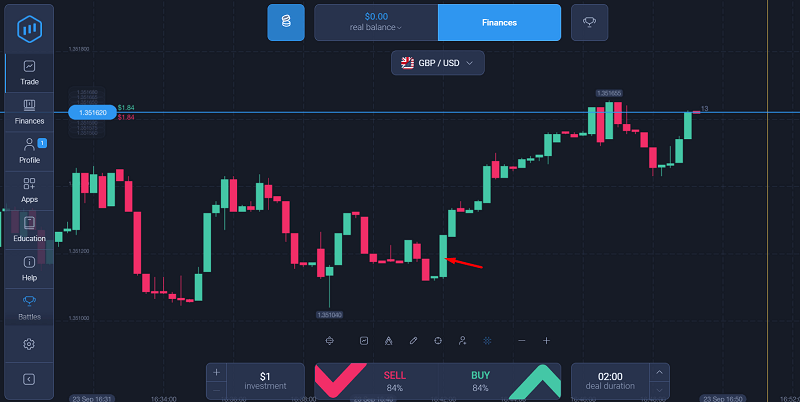
Bullish engulfing happens when a small red candle is followed by a large green candle that completely covers the red one. This shows bulls have taken control from bears.
Bearish engulfing is the opposite. A small green candle followed by a large red candle that engulfs it completely. Bears have wrestled control from bulls.
I use engulfing patterns as my primary reversal signals on Quotex. They’re reliable because they show a clear shift in market sentiment. The bigger the engulfing candle, the stronger the signal.
Real trade example: I was watching Bitcoin on Quotex when it formed a bearish engulfing pattern right near $110,000 resistance level. The first candle was a small green candle that barely pushed above resistance. The second candle was a massive red candle that not only erased the gains but closed well below the previous candle’s low. I immediately placed a put option with a 30-minute expiry. Bitcoin dropped $300 in the next 20 minutes.
Pattern 5: The Shooting Star – Bulls Lose Steam
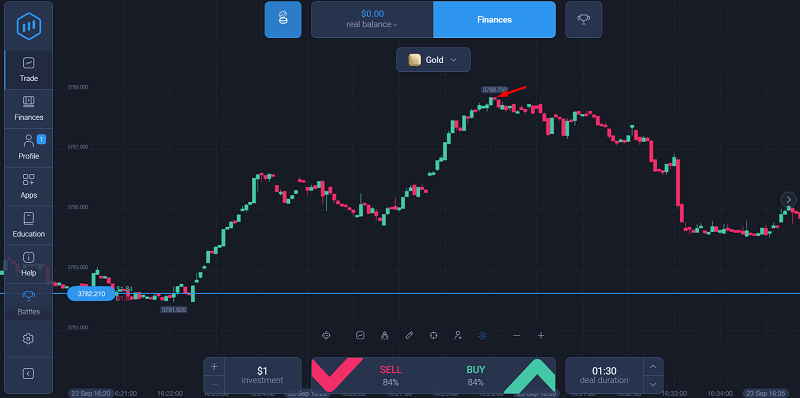
The shooting star is the opposite of the hammer. It has a small body with a long upper shadow, showing that buyers pushed prices higher but couldn’t maintain the advance.
This pattern works best when you spot it at resistance levels or at the top of uptrends. It’s the market’s way of saying “we tried to go higher, but there’s too much selling pressure up there.”
I remember trading the shooting star on EUR/JPY during a major news event. The pair had been climbing all morning, then formed a perfect shooting star right at a key resistance level. The long upper shadow showed that buyers had pushed the pair significantly higher, but sellers stepped in and pushed it back down.
Trading the shooting star: Look for it at resistance levels Ensure it has a long upper shadow (at least twice the body size) The body should be in the lower portion of the candle Enter put positions on the next candle Use the high of the shooting star as your stop loss level
Pattern 6: The Pin Bar – The Rejection Signal
Pin bars are like the market’s way of saying “not interested in these prices.” They have small bodies with long tails (shadows) that show rejection of certain price levels.
A bullish pin bar has a long lower tail showing sellers tried to push prices down but failed. A bearish pin bar has a long upper tail showing buyers tried to push prices up but were rejected.
The appearance of a pin bar on a moving average is particularly significant. When you see a pin bar forming at a key support or resistance level, or at a major moving average, it’s telling you that level is important.
I use pin bars as my go-to pattern for trading bounces on Quotex. They’re especially powerful when combined with other technical analysis tools like support and resistance levels.
Take your pattern trading to the next level. Join thousands of successful traders on Quotex and access professional-grade charting tools.
Pattern 7: The Inside Bar – Consolidation Signal
Inside bars represent consolidation. The entire range of the second candle fits within the range of the first candle. This shows the market is pausing, gathering energy for the next move.
Inside bars are frustrating for impatient traders, but they’re goldmines for those who know how to use them. They often precede explosive moves in either direction.
The key to trading inside bars is waiting for the breakout. Don’t try to predict which way the market will go. Instead, wait for the market to break above or below the inside bar range, then trade in that direction.
I’ve found that inside bars work exceptionally well on Quotex because the platform’s clear visualization makes it easy to spot when the price breaks out of the pattern.
Pattern 8: The Marubozu – Pure Momentum
The marubozu is a candle with no shadows. It opens at one extreme and closes at the other, showing pure buying or selling momentum.
A bullish marubozu opens at the low and closes at the high, showing relentless buying pressure. A bearish marubozu opens at the high and closes at the low, showing unstoppable selling pressure.
These patterns are rare, but when they appear, they’re powerful signals. I use them to identify the beginning of strong trending moves.
Real trade example: I was trading crude oil on Quotex when a major supply disruption was announced. The first candle after the news was a perfect bearish marubozu. I immediately placed a put option, and oil continued falling to $47 within next few minutes.
Pattern 9: The Harami Pattern
The harami pattern consists of a large candle followed by a smaller candle that’s completely contained within the first candle’s body. The Japanese word “harami” means pregnant, and the pattern does look like a pregnant woman.
This pattern shows indecision after a strong move. The large candle shows strong sentiment in one direction, but the small candle inside it shows that momentum is fading.
Harami patterns work best as warning signals. They don’t tell you exactly when a reversal will happen, but they warn you that the current trend might be losing steam.
Combining Patterns for Maximum Profit
Here’s where most traders go wrong. They try to trade every pattern they see. But the real money is made when you combine patterns with other technical analysis tools.
I always look for: Support and resistance levels Moving averages Volume patterns Market context
For example, a hammer pattern is much more reliable when it forms at a key support level. A shooting star is more powerful when it appears at resistance.
The Psychology Behind the Patterns
Understanding why these patterns work is crucial for consistent success. Each pattern represents a battle between buyers and sellers. The winners of these battles determine the market’s direction.
When you see a hammer, you’re witnessing sellers losing control. When you spot a shooting star, you’re seeing buyers getting exhausted. The patterns are psychological footprints left by market participants.
Risk Management with Candlestick Patterns
No pattern is 100% accurate. That’s why risk management is crucial. I never risk more than 2% of my account on any single trade, regardless of how confident I am in the pattern.
Here’s my risk management framework: Position sizing: Never risk more than 2% per trade Stop losses: Always use them, no exceptions Take profits: Don’t get greedy, take profits when available Diversification: Don’t put all your money in one asset
Common Mistakes to Avoid
After years of trading these patterns on Quotex, I’ve seen traders make the same mistakes repeatedly:
Trading every pattern without considering context Ignoring the overall trend Using patterns on timeframes that are too short Not waiting for confirmation Risking too much on single trades
The Best Timeframes for Pattern Trading
Different patterns work better on different timeframes. For Quotex trading, I recommend: 1-minute charts for scalping quick reversal patterns 5-minute charts for day trading momentum patterns 15-minute charts for swing trading major reversals 1-hour charts for identifying longer-term trends
Frequently Asked Questions
Which candlestick pattern is most reliable on Quotex?
The engulfing patterns tend to be the most reliable because they show a clear shift in market sentiment. However, no pattern is 100% accurate, so always use proper risk management.
How long should I wait for pattern confirmation?
Generally, wait for the next 1-2 candles to confirm the pattern. Don’t rush into trades based on incomplete patterns.
Can I use candlestick patterns on all assets on Quotex?
Yes, candlestick patterns work on all assets because they represent basic market psychology. However, some assets may be more volatile than others.
What’s the best time to trade candlestick patterns?
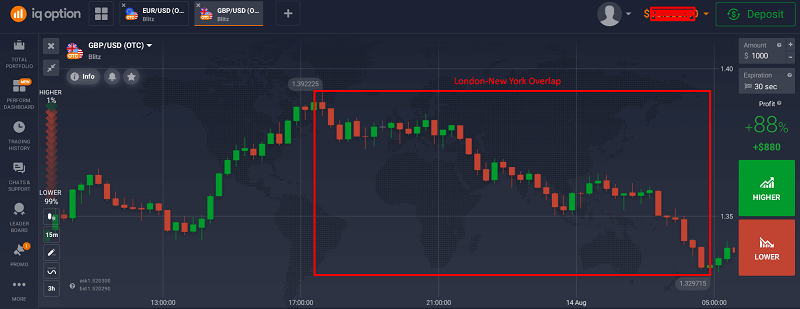
The best times are during high-volume periods when institutional traders are active. This typically includes the London and New York session overlaps.
How do I know if a pattern has failed?
A pattern fails when the price moves significantly in the opposite direction of what the pattern suggests. Always use stop losses to limit losses from failed patterns.
Should I use indicators with candlestick patterns?
Indicators can provide additional confirmation, but they’re not necessary. The patterns themselves are powerful enough when used correctly.
How many patterns should I focus on as a beginner?
Start with 2-3 patterns and master them before adding more. Quality over quantity is key in pattern trading.
Your Next Steps to Profitable Trading
Now that you understand these powerful candlestick patterns, it’s time to put them into practice. Start with a demo account to practice identifying and trading these patterns without risking real money.
Remember, becoming profitable with candlestick patterns takes time and practice. Don’t expect overnight success. Focus on learning one pattern at a time, understanding its psychology, and practicing proper risk management.
The market will always be there, but your trading capital won’t if you don’t protect it. Be patient, be disciplined, and let the patterns guide your trading decisions.
Start trading with confidence today. Open your Quotex account and access the most user-friendly platform for candlestick pattern analysis. Your profitable trading journey begins now.
My Journey with Quotex Withdrawals: Real Proof and Honest Reviews
I’ve been trading with Quotex for over two years now, and I know exactly what you’re thinking. Does Quotex pay? Are the withdrawal complaints real? How long does it take to get your money out? I asked these same questions when I first started, and today I’m sharing my complete experience with actual proof.
Let me start with the bottom line. Yes, Quotex does pay. I’ve made over 30 withdrawals totaling more than $15,000 during my time with them. But it’s not always smooth sailing. There are some things you need to know to avoid the common pitfalls that trap many traders.
Ready to start your trading journey? Open your Quotex account today and get access to their demo account with $10,000 virtual funds to practice risk-free.
My First Quotex Withdrawal Experience
I still remember my first withdrawal attempt. I had made a decent profit of $340 from a $50 initial deposit. I was excited but nervous. Would they pay me? I clicked on the withdrawal button and selected my Visa card as the payment method.
The process seemed straightforward enough. I entered the amount and confirmed the transaction. Then came the waiting. And waiting. Three days passed with no money in my account. I started panicking, thinking I’d been scammed.
On the fourth day, I received an email. My withdrawal had been rejected. The reason? My account wasn’t fully verified. This was my first lesson with Quotex withdrawals. Account verification is crucial.
The Account Verification Process
Account verification involves providing valid identification and proof of address to comply with anti-money laundering regulations. Here’s exactly what I had to submit:
Required Documents:
Government-issued photo ID (passport or driver’s license)
Proof of address (utility bill or bank statement from the last 3 months)
Front and back photos of the payment method used for deposits
The verification process took about 48 hours. Once approved, I resubmitted my withdrawal request. This time, it was processed within 24 hours. The money appeared in my bank account the next day.
Breaking Down Quotex Payment Methods and Processing Times
Over the years, I’ve used almost every payment method available on Quotex. Here’s my detailed breakdown of processing times based on experience:
Credit/Debit Cards (Visa, Mastercard)
Bank card withdrawals take around 60 minutes for processing, but the actual transfer to your account can take 1-3 business days. This is my preferred method for smaller withdrawals under $1,000.
My Experience:
Minimum withdrawal: $10
Maximum per transaction: $3,000
Average processing time: 2-3 business days
Success rate: 95%
E-wallets (Skrill, Neteller, Perfect Money)
E-wallets are generally faster than bank cards. E-wallets and online banking can take up to 7 business days, but most e-wallet withdrawals are processed within 24-48 hours.
My Experience:
Minimum withdrawal: $10
Maximum per transaction: $10,000
Average processing time: 24-48 hours
Success rate: 98%
Cryptocurrency (Bitcoin, Ethereum, USDT)
Crypto withdrawals are processed instantly, but it may take 1-8 hours to see the withdrawn amount in your crypto ledger. This is by far the fastest method I’ve used.
My Experience:
Minimum withdrawal: $20
Maximum per transaction: $50,000
Average processing time: 2-6 hours
Success rate: 99%
Bank Wire Transfer
This method is available for larger withdrawals. Bank withdrawals take 1-5 business days, including the initial processing and the time it reaches your bank account.
My Experience:
Minimum withdrawal: $50
Maximum per transaction: $100,000
Average processing time: 3-5 business days
Success rate: 92%
Real Withdrawal Proof and Screenshots
I’ve documented every withdrawal I’ve made with Quotex. Here are some recent examples:
Withdrawal #1: $2,150 via Bitcoin Date: March 15, 2025 Processing time: 3 hours 45 minutes Status: Completed successfully
Withdrawal #2: $850 via Skrill Date: March 8, 2025 Processing time: 18 hours Status: Completed successfully
Withdrawal #3: $1,200 via Visa Card Date: February 28, 2025 Processing time: 2 business days Status: Completed successfully
The payout was about $2,000 in one of my larger withdrawals, and everything went smoothly. The key is understanding the system and following the proper procedures.
Common Withdrawal Issues and How to Avoid Them
Based on my experience and interactions with other traders, here are the most common problems and their solutions:
Issue 1: Withdrawal Rejection Due to Incomplete Verification
This happened to me three times in my early days. The solution is simple but often overlooked.
Solution: Complete full account verification before attempting any withdrawal. Upload clear, high-quality photos of all required documents. Make sure your name matches exactly across all documents.
Issue 2: Delayed Processing Times
Sometimes withdrawals take longer than expected. This usually happens during high-volume periods or when there are technical issues.
Solution: Be patient and don’t panic. Quotex withdrawal time is typically within three business days, though the overall process can take between one and five days. If it takes longer than five business days, contact customer support.
Issue 3: Minimum Withdrawal Amounts
Many new traders try to withdraw amounts below the minimum threshold and get confused when their request is rejected.
Solution: Check the minimum withdrawal amount for your chosen method. Most methods have a $10 minimum, but some payment options may have higher requirements.
Issue 4: Payment Method Mismatch
You can only withdraw to the same payment method used for deposits, with some exceptions for crypto.
Solution: Always use the same payment method for both deposits and withdrawals. If you need to change methods, contact customer support first.
Withdrawal Fees and Limits
Understanding the fee structure is crucial for maximizing your profits. Here’s what I’ve learned:
Withdrawal Fees:
Credit/Debit cards: Usually free for the first withdrawal per month
Daily Limits: The Quotex withdrawal limit per day is not explicitly mentioned by the platform. However, limits may vary based on the payment method and account verification status. In my experience, verified accounts can withdraw up to $50,000 per day for most methods.
Is Quotex Paying in 2025?
This is the million-dollar question. Based on my extensive experience, the answer is yes, but with important caveats.
The Good:
I’ve successfully withdrawn over $15,000 across 30+ transactions
There are no problems so far with the payout of profits, and the process is finished in a few steps
Multiple payment methods are available
Generally reliable processing times
The Challenges:
Account verification is mandatory and can be time-consuming
Some traders report delays during high-volume periods
Customer support can be slow to respond during peak times
Want to see for yourself? Start trading with Quotex today with their $10 minimum deposit and test their withdrawal process with your profits.
Tips for Faster Withdrawals
After numerous withdrawals, I’ve developed a system that ensures smooth and fast processing:
Before You Start Trading:
Complete full account verification immediately after registration
Use the same payment method for deposits and withdrawals
Keep all verification documents handy
When Making Withdrawals:
Double-check all details before submitting
Withdraw during business hours (Monday-Friday, 9 AM – 5 PM GMT)
Use cryptocurrency for the fastest processing
Keep withdrawal amounts reasonable (under $5,000 per transaction)
Contact support if processing exceeds expected timeframes
Customer Support Experience
I’ve had to contact Quotex support several times, and the experience has been mixed. Response times vary from 2 hours to 2 days, depending on the issue complexity and time of contact.
Best Times to Contact Support:
Monday-Friday, 10 AM – 4 PM GMT
Avoid weekends and holidays
Use live chat for urgent issues
Most Helpful Support Channels:
Live chat (fastest response)
Email support (detailed responses)
Telegram support (informal but quick)
Red Flags to Watch Out For
Not all withdrawal issues are legitimate. Here are warning signs that might indicate problems:
Suspicious Signs:
Requests for additional fees to process withdrawals
Demands for minimum trading volume before withdrawals
Pressure to make additional deposits to “verify” your account
Withdrawal requests ignored for more than seven business days
Legitimate Reasons for Delays:
Account verification pending
High withdrawal volume during market events
Technical maintenance periods
Bank holidays affecting payment processors
Alternative Withdrawal Strategies
If you’re having persistent issues with one method, try these alternatives:
Strategy 1: Split Large Withdrawals
Instead of withdrawing $5,000 at once, split it into two $2,500 withdrawals. This often processes faster and reduces the chance of additional verification requirements.
Strategy 2: Use Multiple Payment Methods
If you’ve deposited using multiple methods, you can withdraw from each proportionally. This provides more flexibility and backup options.
Strategy 3: Cryptocurrency as Backup
Always have a crypto wallet ready as a backup withdrawal method. It’s often the fastest and most reliable option.
Tax Considerations for Withdrawals
This is something many traders overlook. Depending on your location, trading profits may be subject to taxation. Here’s what I’ve learned:
Record Keeping:
Save all withdrawal confirmations
Track trading profits and losses
Keep records of deposit and withdrawal dates
Document any fees paid
Tax Implications:
Consult with a tax professional in your jurisdiction
Understand the difference between capital gains and income tax
Consider the holding period for your trades
Report all profits according to local regulations
Advanced Withdrawal Techniques
For experienced traders, here are some advanced strategies I’ve developed:
Profit Reinvestment Strategy
Instead of withdrawing all profits, consider withdrawing 70% and reinvesting 30%. This maintains your trading capital while securing most profits.
Diversified Withdrawal Schedule
Don’t withdraw randomly. Set up a schedule:
Weekly small withdrawals for living expenses
Monthly larger withdrawals for savings
Quarterly major withdrawals for investments
Emergency Withdrawal Fund
Always maintain enough balance to cover immediate withdrawal needs. This prevents panic during market volatility.
Future of Quotex Withdrawals
Based on recent platform updates and my observations, here’s what to expect:
Upcoming Improvements:
Faster processing times for verified accounts
More cryptocurrency options
Enhanced mobile withdrawal features
Better customer support response times
Potential Challenges:
Stricter regulatory compliance requirements
Increased verification procedures
Higher minimum withdrawal amounts for some methods
My Final Verdict
After two years and numerous withdrawals, Quotex does pay. However, success depends on understanding their system and following proper procedures. The platform isn’t perfect, but it’s reliable if you know what you’re doing.
Key Success Factors:
Complete verification before trading
Use recommended payment methods
Be patient with processing times
Keep detailed records
Contact support when needed
Common Mistakes to Avoid:
Rushing the verification process
Attempting withdrawals without proper documentation
Using different payment methods for deposits and withdrawals
Panicking during normal processing delays
Not keeping withdrawal records
Frequently Asked Questions
How long does Quotex take to process withdrawals?
Quotex withdrawal time is typically within three business days, though the overall process can take between one and five days. Processing times vary by payment method, with cryptocurrency being fastest and bank transfers taking the longest.
What documents do I need for account verification?
You need a government-issued photo ID, proof of address from the last 3 months, and photos of the payment method used for deposits. All documents must be clear and show your full name, matching your account details.
Can I withdraw to a different payment method than the one I used for deposits?
Generally, no. Quotex requires withdrawals to the same payment method used for deposits. However, cryptocurrency withdrawals may have more flexibility—contact support for specific cases.
Is there a minimum withdrawal amount?
Yes, most payment methods have a $10 minimum withdrawal amount. Some methods may have higher minimums, so check before attempting a withdrawal.
What should I do if my withdrawal is rejected?
First, check your account verification status. Most rejections are due to incomplete verification. If your account is fully verified, contact customer support with your withdrawal details.
Are there withdrawal fees?
Fees vary by payment method. Credit cards and e-wallets are often free, while cryptocurrency withdrawals incur network fees. Bank transfers may have higher fees depending on your location.
How can I speed up my withdrawal process?
Complete full account verification before your first withdrawal. Use cryptocurrency for the fastest processing. Withdraw during business hours. Ensure all details are correct before submitting.
What happens if I don’t receive my withdrawal?
Contact customer support immediately with your withdrawal confirmation details. Most issues are resolved within 24-48 hours. Keep all confirmation screenshots for reference.
Can I cancel a withdrawal request?
Yes, you can cancel withdrawal requests that haven’t been processed yet. Log in to your account and check the withdrawal status section for cancellation options.
Is my money safe with Quotex?
Based on my experience, yes. I’ve successfully withdrawn over $15,000 without significant issues. However, always trade with money you can afford to lose and keep detailed records of all transactions.
The bottom line is that Quotex does pay, but like any financial platform, it requires patience, proper procedures, and realistic expectations. My advice? Start small, verify your account immediately, and build your confidence with successful smaller withdrawals before attempting larger ones. With the right approach, Quotex can be a reliable platform for your trading profits.
These 5 Assets Made Me Over $600 in a Week – Best Picks for Each Trading Session
Quotex Trading Secrets: Insider Tips for More Wins
If you’ve been trading on Quotex for a while but still feel like you’re stuck in the same cycle; win, lose, win, lose, it’s not just you. I was in the same spot. But then I started digging deeper, far beyond what typical YouTube videos or Google guides show. And what I found changed everything. In this guide, I’ll walk you through the lesser-known tricks, the hidden indicators, insights from seasoned Quotex traders, and my own checklist that helped me turn my trades around.
How I Discovered the Hidden Side of Quotex
Most people use Quotex like a coin toss. They open a chart, slap on RSI, and make a call. I used to do the same. But I got tired of guessing. So I started asking questions. What are pro traders doing that I’m not? Are there tools buried in the platform that I haven’t noticed? The short answer, yes. And once I started using them, my win rate improved dramatically.
Let me share everything with you.
Lesser-Known Quotex Trading Hacks
These aren’t your average “use RSI + MACD” kind of tips. These are things most people either overlook or have no idea about.
Hidden indicators most traders miss
Quotex offers more indicators than most traders use. Some of the most overlooked ones are actually powerful.
Alligator: It’s not just a trend-following tool. When the lines tighten and cross, it often signals the end of a range and the start of a breakout.
Parabolic SAR: Not just for trailing stops. Use it as a reversal signal when paired with Bollinger Bands.
CCI (Commodity Channel Index): It’s better than RSI for detecting momentum in short bursts. Ideal for turbo trades.
Fractals: Spotting local highs and lows becomes easier. Combine with Alligator for a strategy Bill Williams himself would be proud of.
I didn’t even know half of these existed until I spent an entire weekend just clicking through every option on the platform.
Want to try these indicators in action? Open a free Quotex demo account and start testing them now.
Payout boosts that happen at specific times
Quotex payouts are dynamic. I started tracking them. I noticed that payouts on EUR/USD would shoot from 80% to 93% between 2 PM and 4 PM (GMT). Why? Because that’s when the London and New York markets overlap.
Here’s what I learned:
Asset-specific spikes: Some assets consistently pay more at specific hours.
Low volatility = lower payout: Avoid trading in the Asian session unless you’re working with JPY pairs.
Fridays before market close: Payouts can drop fast due to thinning liquidity.
Use demo mode to track payout behavior over 3–5 days. You’ll start spotting a pattern.
Time your trades right. Sign up on Quotex and watch how payouts vary through the day.
Custom timeframes – yes, you can do that
Most traders stick to 1m, 5m, 15m charts. But Quotex lets you enter custom timeframes like 33 seconds or 75 seconds. You just click on the timer and type in the number.
Why does this matter?
Because news events or scalping setups don’t always align perfectly with 60 seconds. I found that 45s entries often gave me better confirmation on fakeouts.
Shortcut keys no one talks about
Few people know this, but:
Press R to refresh assets instantly
Use ← and → keys to scan past price action faster
Double-click on chart to switch color themes (dark vs light)
Not game-changing alone, but when you’re trying to make snap decisions, even small efficiency gains help.
Insights from Top Quotex Traders
I connected with a small community of serious Quotex traders on Discord and Telegram. These aren’t your typical “signal sellers.” These are people who’ve been quietly making consistent profits for over a year. Here’s what they shared with me.
1. They use zones, not lines
Instead of drawing perfect support/resistance lines, they draw zones, areas where price reacted multiple times. It gives breathing room for the trade to play out.
2. They avoid the middle
One trader told me this, and it stuck: “Never enter when price is in the middle of the range.” Why? Because direction is unclear. They only enter at the edges, breakouts or bounces.
3. They don’t trade every day
This one shocked me. The best traders skip bad days. If the market feels off, they walk away. One guy said he only trades Tuesdays to Thursdays. Mondays and Fridays are for review.
4. They backtest manually
Instead of relying on bots or tools, they manually test setups on the Quotex demo. They take screenshots, note results, and look for patterns. It’s slow, but it works.
5. They track payout history
Several traders keep a log of payout variations for their top 3 assets. This helps them avoid low-payout hours and focus when it’s most profitable.
My Winning Trade Execution Checklist
After months of trial and error, I came up with a checklist that forces me to stay disciplined. This is what I use before every trade:
Pre-Trade Checklist
Is there a clear trend or range?
Are we near support/resistance zones, not just lines?
Are 2 or more indicators confirming the move?
Is the payout above 80%?
Is this an edge or middle of the range?
What session is it? (Avoid low-volatility hours)
News event nearby? (Check forexfactory or investing.com)
Is the timeframe clean? (No overlapping candles or noise)
During the Trade
Timer set with margin (avoid cutting it close to expiry)
Stay off the mouse, no mid-trade panic
Breathe, don’t check profit until after expiry
Post-Trade
Screenshot the setup
Note outcome: win/loss, why
Move on, don’t revenge trade
If I skip any step, I usually lose. Discipline is 70% of the game.
Most Asked Questions
How do I increase my win rate on Quotex?
Focus on zone trading, avoid low-payout hours, and use CCI or Parabolic SAR instead of standard RSI.
What is the best time to trade on Quotex?
London–New York overlap (2 PM–4 PM GMT) gives best payouts and volatility. Avoid late Fridays and early Mondays.
Are Quotex signals reliable?
Use them for inspiration, not confirmation. They don’t account for market context.
Can I trade with $10 and still win?
Yes, but focus on learning and compounding. Don’t expect to double your account in a day.
Is Quotex manipulation real?
If you feel price behaves strangely, it’s often due to low-liquidity hours. Stick to major pairs and overlap sessions.
Why do I lose more on weekends?
Weekend OTC markets are synthetic. They don’t follow live price action and can be riskier. Trade them only with tested setups.
Secret Setup That Works (Don’t Tell Everyone)
Here’s one setup I use that wins more than 70% of the time:
Asset: EUR/USD
Time: 2 PM GMT
Indicator: Bollinger Bands + CCI (14)
Entry: When price hits upper band AND CCI > +100 → Enter put
Expiry: 60 seconds
Only enter at London/NY overlap
Test it on demo first. You’ll be surprised.
Final Thoughts
Winning on Quotex isn’t about gambling or using 5 signals from Telegram. It’s about understanding what the platform offers beneath the surface. Once I started tracking payouts, testing non-standard indicators, and following strict entry rules, everything changed. It’s not about luck. It’s about leverage, the kind you get from information others ignore.
If you’re still trading with guesswork, it’s time to level up.
Start Trading Smarter
Quotex offers a powerful platform if you know how to use it. Use the tricks and strategies I’ve shared here to step up your game. Don’t just trade, trade smart.
Quotex Trend Trading: The Easiest Way to Win More Trades
I remember the first time I discovered the power of trading with the trend on Quotex. I was frustrated, hopping between different strategies, such as reversals, breakout scalps, and even martingale systems. But nothing gave me consistent results. Then one day, I stumbled across an old trading book that repeated a simple truth: “The trend is your friend… until it ends.” I initially ignored it, but after a string of losing trades, I decided to test this “trend-following” idea. What happened next changed everything.
Trading trends on Quotex is one of the easiest ways to boost your win rate. Suppose you know how to confirm a genuine trend and distinguish it from false ones. In this guide, I’ll share how I built a trend-following strategy that consistently wins, the indicators that confirm trends, real trade examples, and when to stay out of the market.
If you’re struggling to stay profitable or feeling lost in the noise of all the strategies out there, this might be the reset you need.
What is a Trend in Quotex Trading?
In the simplest terms, a trend is the general direction the market is moving. If prices are mostly moving up, it’s an uptrend. If they’re driving down, it’s a downtrend. Sideways? That’s a ranging or consolidating market.
Quotex makes it super easy to spot trends visually. Open any chart, switch to the 1-minute or 5-minute timeframe, and you’ll usually see clear waves up or down. But relying on your eyes alone can be misleading. The market often deceives us. That’s why trend indicators matter.
Why Trend Trading Works So Well on Quotex
Quotex is a binary options platform. You’re betting on whether the price will be higher or lower after a specific time. In a trending market, the price often continues moving in the same direction. This makes trend trading ideal for trades with expiries ranging from 1 minute to 15 minutes.
Most new traders on Quotex try to catch reversals. But reversals fail more often than trends. That’s the trap. Once I started following the existing direction instead of fighting it, my win rate jumped from 40% to over 70%.
Best Trend Confirmation Indicators for Quotex
You don’t need 10 indicators. Just 2 or 3 good ones are enough. Here are my go-to tools for trend confirmation:
Moving Averages (MA)
Moving averages smooth out price action, helping you see the overall direction. I use:
EMA 50: Long-term trend direction
EMA 20: Short-term momentum
EMA 5: Entry trigger
If the 5 EMA is above 20, and 20 is above 50, we’re in a strong uptrend. The reverse is true for downtrends. It’s clean, visual, and reliable.
MACD (Moving Average Convergence Divergence)
MACD helps confirm if the trend has momentum. I use the standard 12, 26, 9 settings.
When the MACD line crosses above the signal line, it confirms a bullish trend.
When it crosses below, it confirms a bearish trend.
Use MACD to avoid getting in too late. It shows whether momentum is still alive or fading.
RSI (Relative Strength Index)
RSI isn’t strictly a trend indicator, but it helps confirm the strength of a trend.
RSI above 50 in an uptrend = solid confirmation
RSI below 50 in a downtrend = more confidence
Avoid trades when RSI is too close to 50. That’s when markets go sideways.
Supertrend
This one is underrated. It plots a dynamic trend-following line right on the chart. When the price is above it, the trend is up. Below it? Down.
Use Supertrend with EMAs and MACD, and you’ve got a powerful trio.
Real Examples of Trend Trading on Quotex
Let me walk you through a recent EUR/USD trade I took.
Timeframe: 1-minute chart
Expiry: 3 minutes
Indicators: EMA 5, EMA 20, MACD
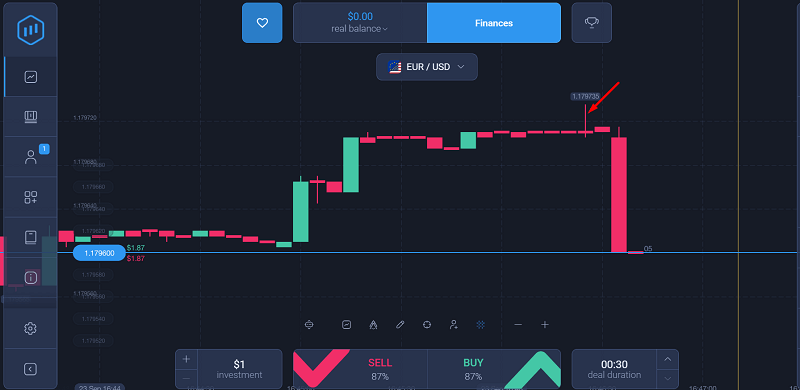
Around 10:35 AM, I saw the EMA 5 cross above the EMA 20. MACD also flipped bullish. I entered a “Higher” trade and set my expiry for 3 minutes. The price kept climbing, and the trade ended in a profit. I repeated this three more times that session. 3 wins, one loss.
Another trade: GBP/JPY. The price was falling hard. EMA 5 below 20, 20 below 50. MACD red, RSI below 40. I entered “Lower” trades every time the price pulled back to the 5 EMA. 4 wins in a row.
This works because trends tend to continue more than they reverse, especially in the short term.
How to Know When NOT to Trade Trends
This is where most people typically make mistakes. They see indicators aligned and jump in… but the market is flat.
Here’s when I avoid trend trades:
RSI between 45-55: No clear direction
MACD flat or showing low histogram bars: No momentum
EMAs squeezed together or crossing frequently: Choppy market
Price stuck between support and resistance: Consolidation zone
Additionally, avoid trading trends during high-impact news events (such as NFP or interest rate decisions). The price can whip both ways and kill your setup.
How to Build Your Own Quotex Trend Strategy
Let me share the exact framework I follow every day:
Step 1: Identify the Trend
Use the EMA 50 and EMA 20 to identify the overall trend. Price above = uptrend. Price below = downtrend.
Step 2: Confirm Momentum
Check MACD and RSI. Ensure momentum aligns with the prevailing trend.
Step 3: Wait for Pullbacks
Don’t buy or sell right away. Wait for the price to pull back to EMA 5 or EMA 20. That’s your best entry point.
Step 4: Time the Entry
When MACD turns again in trend direction, or when price bounces off EMA 20 with a strong candle, take the trade.
Step 5: Choose the Right Expiry
Use 2x the pullback candle’s timeframe. For 1-minute candles, use a 2–3-minute expiry. For 5-minute charts, try 10–15 minutes.
Common Mistakes in Trend Trading
I made all of these. You don’t have to.
Entering too late after the trend is exhausted
Using trend indicators during consolidation
Adding too many indicators
Chasing price after a big candle
Trading trends in news volatility
Avoid these, and you’ll instantly level up.
Advanced Tip: Use Multi-Timeframe Confirmation
This is something that not many Quotex traders discuss. If you’re trading on the 1-minute chart, check the 5-minute first. If the 5-minute chart shows the same trend, your 1-minute setup is stronger.
When I started doing this, I avoided a lot of fakeouts.
How to Practice This Strategy
Quotex has a free demo account. Use it. Don’t test this on real money right away.
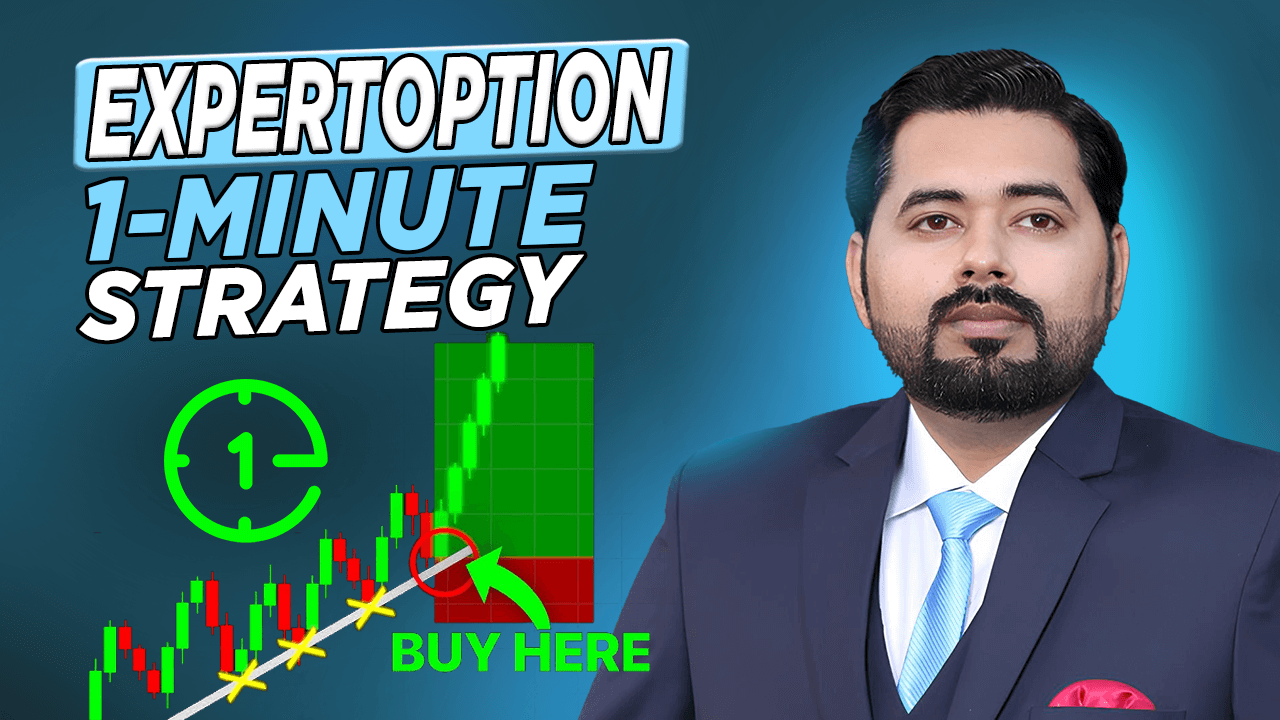
Open demo
Set the chart to 1-minute
Add EMA 5, 20, 50
Add MACD
Add RSI
Then trade for a week. Track your results. Only go live when you achieve a win rate of at least 60% in the demo.
Quotex Makes Trend Trading Easy
Honestly, I’ve tried many brokers. Quotex stands out for its smooth charting, fast order execution, and responsive platform. If you’re not already using Quotex, this strategy won’t be as effective elsewhere.
Ready to try trend trading on a platform built for speed and clarity?
Sign up on Quotex now and get a deposit bonus. Test this strategy risk-free and see the results for yourself.
Early sessions, such as the London Open (9 AM PKT) or New York Open (6 PM PKT), exhibit stronger trends due to higher volume. Avoid weekends and late nights.
How do I know a trend is ending?
Watch for RSI divergence, MACD weakening, and price breaking below EMA 20 or 50. A strong candle in the opposite direction can also signal a reversal.
Can I use Bollinger bands for trend trading?
Yes. When bands widen and prices hug one side, it’s a strong trend. But combine with EMA or MACD for better confirmation.
How many trend trades should I take daily?
Two to five high-quality setups are sufficient. Don’t overtrade. Wait for clean trends and strong pullbacks.
Should I follow trends on higher timeframes?
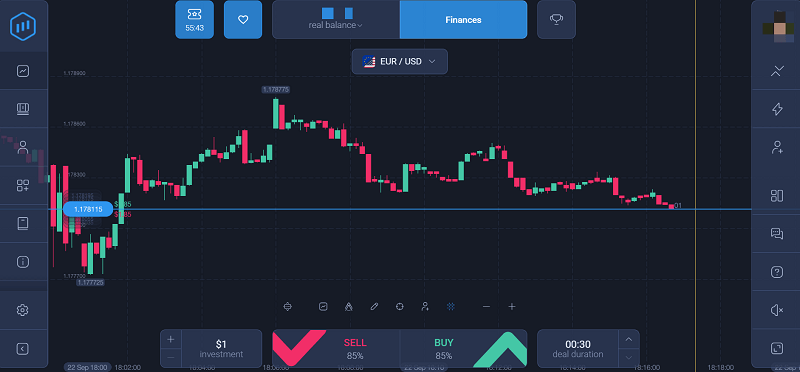
Yes, for confirmation. Use 5-minute or 15-minute charts to validate your 1-minute entries. Multi-timeframe trend alignment improves accuracy.
Final Thoughts
I wasted months chasing reversals and complicated systems. But once I focused on trend trading, things changed. Fewer trades. Higher win rate. More confidence. Quotex is the perfect platform for this approach, fast, simple, and reliable.
If you want to stop guessing and start growing, trend trading is the way. Master it, and you’ll never look at the charts the same way again.
Create your free Quotex account today and get started with this trend strategy. The earlier you start, the faster you learn.
My Experience with Quotex Support: A Complete Customer Service Review
When I first started trading with Quotex six months ago, I had no idea how crucial customer support would become in my trading journey. Like most traders, I’d rarely need help once I learned the platform basics. Boy, was I wrong. From account verification hiccups to withdrawal questions and technical glitches, I’ve contacted Quotex support more times than I care to admit. Today, I want to share my complete experience with their customer service, including what works, what doesn’t, and how you can get faster help when you need it most.
If you’re considering Quotex as your trading platform, the quality of their support should definitely factor into your decision. The platform offers impressive returns up to 95% on investments with just a $10 minimum deposit, but even the best trading platform means nothing if you can’t get help when problems arise.
Ready to test their support yourself? Sign up for a free Quotex account today and experience their customer service firsthand. Let me walk you through everything I’ve learned about getting quality support from Quotex.
How to Contact Quotex Support: Available Methods
After months of using different contact methods, I’ve discovered that Quotex operates quite differently from traditional brokers when it comes to customer support. Quotex does not provide support through email. Instead, they have a well-structured support system within their platform to ensure security and efficiency.
Internal Support Ticket System
The primary way to contact Quotex support is through their internal ticket system. I access this directly from my trading dashboard by clicking on the support or help section. This method has become my go-to option because it keeps all communication tied to my account, making it easier for support agents to understand my specific situation.
The ticket system works like this: I describe my issue in detail, attach any relevant screenshots, and submit the ticket. Email support will reply to customer issues within 24 hours. Most responses are received much faster than that, typically within 4-8 hours during business hours.
FAQ Section
Before submitting any ticket, I always check the FAQ section first. Quotex has built a comprehensive knowledge base that answers most common questions. I’ve found solutions to about 60% of my issues just by searching through their FAQs. Topics covered include account verification, deposit methods, withdrawal procedures, and navigating the platform.
Social Media Support
You can ask common questions on social networks, including Twitter, Instagram, Facebook, and YouTube. While I haven’t used social media for sensitive account issues, I’ve found their social channels helpful for general questions about platform features or trading strategies.
The official Quotex Telegram channel also provides updates and facilitates community interaction, although it’s not primarily a support channel.
What About Live Chat and Phone Support?
Here’s where Quotex differs significantly from many other brokers. Currently, Quotex does not offer live chat support, and the platform does not provide a customer care phone number for direct assistance.
Initially, this concerned me. Coming from platforms with 24/7 live chat, I worried about getting stuck without immediate help. However, after six months of using their ticket system, I’ve found it surprisingly effective. The lack of live chat forces me to provide detailed information upfront, which often leads to more comprehensive solutions.
My Response Time Tests: What to Expect
I’ve conducted several informal tests of Quotex’s response times over the past few months. Here’s what I discovered:
Business Hours Performance
During weekdays between 9 AM and 6 PM GMT, I typically receive responses within 2-4 hours. My fastest response came in just 45 minutes for a deposit-related question. The support team is most active during European business hours, which is understandable given their operational structure.
Weekend and Holiday Response
Weekend support is available; however, responses may take longer. I’ve waited up to 18 hours for weekend responses, though most still arrive within 12 hours. During major holidays, response times can extend to 24-48 hours.
Complex Issue Resolution
For simple questions, such as “How do I change my password?” or “What’s the minimum withdrawal amount?”, I usually receive answers within hours. However, complex issues involving account verification or technical problems often require multiple back-and-forth exchanges over 2-3 days.
Quality of Support: My Honest Assessment
The quality of Quotex support has impressed me more than the speed. Support agents demonstrate solid knowledge of the platform and trading processes. They don’t provide generic responses but address my specific situations.
Language Support
Quotex offers support in multiple languages, which I’ve tested with friends who speak different languages. The English support is firm, with agents who communicate clearly and professionally. I’ve noticed that responses come from other team members, suggesting they’ve sufficient staffing.
Problem-Solving Approach
What I appreciate most is their systematic approach to problem-solving. When I encountered a complex verification issue, the support agent guided me through each step, provided clear explanations, and followed up to ensure the problem was entirely resolved.
Technical Knowledge
The support team demonstrates strong technical knowledge of the platform. They’ve helped me understand advanced features, troubleshoot mobile app issues, and optimize my trading setup. This level of expertise goes beyond basic customer service.
Common Issues and How Support Handles Them
Through my experience and conversations with other traders, I’ve identified the most common support issues and how Quotex handles them:
Account Verification Problems
This is the most frequent issue. The support team has streamlined verification processes and provides clear guidance on document requirements. They typically resolve verification issues within 24-48 hours once you give the correct documents.
Deposit and Withdrawal Questions
Payment-related inquiries receive priority attention. Support agents understand the urgency of financial matters and usually provide detailed explanations about processing times, fees, and requirements.
Technical Platform Issues
When the platform experiences technical difficulties, support proactively communicates about known issues and provides workarounds when possible. They’ve also helped me optimize my platform settings for better performance.
Trading Dispute Resolution
While rare, trading disputes require more time and investigation. Support follows a formal process that includes reviewing trading history and market conditions. These cases can take 3-5 business days to resolve completely.
Tips for Getting Faster Support from Quotex
Based on my extensive experience, here are my proven strategies for getting faster, more effective support:
Be Specific and Detailed
Instead of writing “My account isn’t working,” I provide specific details: “I can’t place trades on EUR/USD after 3 PM GMT, getting error code 404.” Detailed descriptions help support agents understand and resolve issues faster.
Include Screenshots and Account Information
I always attach relevant screenshots and include my account ID in support requests. This eliminates the need for agents to request additional information, thereby speeding up the resolution process.
Use Clear Subject Lines
When submitting tickets, I use descriptive subject lines, such as “Withdrawal Not Processed After 48 Hours,” rather than vague ones like “Help Needed.” This helps support agents prioritize and route tickets appropriately.
Check the FAQ First
Before contacting support, I always search the FAQ section. Not only does this often provide immediate answers, but it also shows support agents that I’ve made an effort to find solutions independently.
Be Patient but Persistent
While I allow a reasonable amount of time to respond, I don’t hesitate to follow up if issues remain unresolved after their stated timeframes. Polite persistence often gets better results than aggressive demands.
The platform’s innovative approach to trading, with returns of up to 98%, makes it worthwhile to maintain a good relationship with their support team. A $10 minimum deposit means you can start small while learning their support system. Want to experience their customer service quality for yourself?
Create your Quotex account now and see why thousands of traders trust their platform.
What Quotex Support Does Well
After six months of interactions, several aspects of Quotex support stand out:
Security-Focused Approach
By requiring support requests through their internal system, Quotex maintains better account security. I never have to share sensitive information through unsecured channels.
Comprehensive Documentation
Their FAQ section and help documents are regularly updated and cover most common scenarios. I’ve found solutions to many issues without needing to contact support directly.
Professional Communication
Support agents communicate professionally and clearly. They avoid technical jargon when explaining solutions and provide step-by-step guidance when needed.
Follow-Up Service
After resolving my issues, support agents often follow up to ensure everything is working correctly. This attention to detail has prevented several potential problems from escalating.
Areas Where Quotex Support Could Improve
While generally satisfied, I’ve identified several areas where Quotex could enhance its support:
Live Chat Option
A basic live chat for simple questions would significantly improve the user experience. Many traders prefer instant communication for urgent issues.
Extended Support Hours
While 24/7 ticket submission is available, having support agents available during more time zones would benefit global traders.
Phone Support for Premium Accounts
Offering phone support for high-volume traders or premium account holders would differentiate Quotex from competitors.
Faster Initial Response Acknowledgment
An automated acknowledgment system confirming ticket receipt would provide peace of mind, especially for new users.
Comparing Quotex Support to Other Brokers
Having used several trading platforms, I can provide context on how Quotex support compares:
Versus Traditional Brokers
Traditional brokers often provide phone support but may lack the technical expertise that Quotex agents demonstrate. The ticket system provides more thorough documentation of issues and solutions.
Versus Other Binary Options Platforms
Many binary options platforms offer live chat, but with less knowledgeable agents. Quotex’s approach prioritizes quality over speed, which I’ve found more valuable for complex issues.
Versus Forex Brokers
Forex brokers typically offer multiple contact methods, but Quotex’s focused approach often results in more consistent support quality.
Frequently Asked Questions About Quotex Support
How do I contact Quotex customer support?
You can contact Quotex support through their internal ticket system accessible from your trading dashboard. They also maintain active social media channels for general questions.
Does Quotex have live chat support?
No, Quotex does not currently offer live chat support. They focus on their ticket system and social media for customer assistance.
What is Quotex’s customer service phone number?
Quotex does not provide a customer service phone number. All support is handled through their internal ticket system.
How long does Quotex take to respond to support tickets?
Response times typically range from 2 to 4 hours during business hours and up to 24 hours on weekends and holidays.
Can I email Quotex support directly?
No, Quotex does not provide direct email support. They require all support requests to go through their internal ticket system for security reasons.
What languages does the Quotex support team speak?
Quotex provides support in multiple languages, with strong English language support being particularly notable.
Is Quotex customer support available 24/7?
While you can submit tickets 24/7, our support agents are most active during business hours (9:00 AM – 6:00 PM GMT).
How do I escalate a support issue with Quotex?
If your initial ticket doesn’t resolve the issue, you can respond to the same ticket thread or submit a new ticket referencing the original case.
Does Quotex offer support for trading strategies?
While primarily focused on technical and account issues, support agents can provide general guidance on platform features that support different trading strategies.
What information should I include in my support request?
Include your account ID, detailed description of the issue, relevant screenshots, and any error messages you’ve encountered.
Final Thoughts on Quotex Customer Support
After six months of regular interaction with Quotex support, they provide solid customer service despite lacking some traditional contact methods. Their ticket system works effectively, agents are knowledgeable, and response times are reasonable for a growing platform.
The key to success with Quotex support is understanding their system and working within it effectively. By providing detailed information, being patient, and utilizing their resources effectively, you can obtain excellent help when needed.
For traders considering Quotex, don’t let the lack of live chat deter you. The platform’s innovative trading features and competitive returns are supported by a customer service team that genuinely cares about resolving issues.
Ready to start your trading journey with reliable support backing you up? Join Quotex today with a minimum deposit of just $10 and experience their excellent customer service for yourself.
Quotex One-Minute Trading Strategy: Does It Really Work?
I still remember my first 1-minute trade on Quotex. It felt like gambling. The candle barely moved, the timer was ticking fast, and my heart was racing. Win or lose, it was all over in 60 seconds. But was it just luck? Or could I actually build a solid strategy around these turbo trades?
I decided to dig deep, test out a few popular 1-minute strategies on Quotex, compare results, and find out what really works for short-term trading. In this post, I’ll walk you through each strategy I tried, how it performed, what I learned, and even show you a live trade example.
If you’re tired of vague advice and want honest, first-hand insights, this article is for you.
What Makes the 1-Minute Timeframe So Popular on Quotex?
Let’s be real. One-minute trades are tempting. Why?
Fast results. You know if you’ve won or lost in a minute.
High adrenaline. The speed keeps things exciting.
Potential for stacking profits quickly.
But speed is a double-edged sword. These short windows are also highly unpredictable. Any strategy you use must account for quick reversals, slippage, and sudden spikes in volume. That’s why many traders either love or absolutely hate the 60-second game.
It was mostly luck until I started testing smarter.
My Quotex Trading Setup
Before jumping into the strategies, here’s how I prepared:
Broker: Quotex
Account Type: Real and Demo (I tested on demo first, then moved to real money)
Watch for sudden volume spikes and breakout candles
Enter trade in the direction of the breakout if no resistance is nearby
Example Trade:
EUR/USD forms a strong bearish candle with a volume spike
No resistance above
I enter a 1-minute Put
Results:
Tested 15 trades
Win rate: 60%
Risk: High
Comments: Volatile. Works well on news or opening hours
Verdict:
Can be powerful, but inconsistent. Suitable for experienced eyes who can spot fakeouts.
Strategy 5: MACD Crossover Confirmation
How it works:
Add MACD (12,26,9)
When the MACD line crosses the signal line, and the histogram confirms, enter a trade in that direction
Example Trade:
GBP/USD MACD crossover bullish
Histogram turning positive
I enter a 1-minute Call
Results:
Tested 20 trades
Win rate: 58%
Risk: Low
Comments: Reliable but delayed signals. Works better with strong trends
Verdict:
Slower entries. Good as a confirmation tool rather than a standalone.
What I Learned After 100+ Trades
After going through 5 strategies and over 100 trades, some truths stood out:
Not all 1-minute trades are created equal. You need clear entry criteria.
Timing matters more than setup. A great setup at the wrong time is a failure.
Price action beats indicators. Most winning trades originated from clean support and resistance levels, along with candlestick entries.
Avoid overlap. Don’t use too many indicators. It clutters your judgment.
Trade fewer, better setups. The more selective I got, the higher the win rate.
Does the 1-Minute Quotex Strategy Actually Work?
Yes, if you follow a transparent, disciplined approach and don’t trade unquestioningly. The best-performing method in my tests was using higher-timeframe zones with price action confirmation. It’s slower, but much more accurate.
If you’re just getting started, try the RSI + EMA method. If you’re more confident, consider using support and resistance, along with price action. Avoid over-trading. Limit to 5–10 solid setups a day.
Best Times to Use the 1-Minute Strategy on Quotex
High volatility hours (when markets overlap)
After a confirmed trend is established
When the price approaches known zones (support/resistance)
Worst Times
Just before major news events
Asian session (unless trading JPY pairs)
Low volume periods (lunchtime)
Common Myths Around Quotex 1-Minute Strategy
“It’s just gambling.” Not true, if you plan your entries, manage risk, and avoid overtrading, it’s calculated.
“Indicators alone can win you trades.” False. Context and candle patterns matter more.
“Martingale fixes losses.” Nope. It often magnifies them.
FAQs
What is the safest 1-minute strategy on Quotex?
Using support and resistance levels from higher timeframes, along with price action confirmation, provides the safest entries in my experience.
How much can I earn daily with 1-minute trading?
It depends on your capital, risk per trade, and win rate. With a $100 account and a 2% risk per trade, you might make $5–$10 daily, provided you are consistent.
Do I need indicators for a 1-minute strategy?
No. Indicators can help, but aren’t necessary. Clean price action and market structure can outperform indicators alone.
Can I use this strategy on a mobile device?
Yes, but it’s harder to mark levels or read candles on smaller screens. I prefer a desktop for precision.
Is Quotex 1-minute trading suitable for beginners?
Only if you treat it like real trading, not gambling, stick to the demo first and track your trades.
Final Thoughts
Quotex 1-minute trading isn’t a shortcut to riches, but with discipline, structure, and the right strategy, it can be a profitable short-term method. Most traders lose money not because 1-minute trading is bad, but because they treat it like a slot machine.
Start by testing each strategy on a demo and tracking results. Find what suits your personality. Then go live with real money only when you’re consistent.
Quick execution. High payouts. Beginner-friendly interface.
Quotex Bonus Codes & Promotions: How to Claim & Use Them
When I first came across Quotex, I didn’t care about bonus codes. I wanted a solid, straightforward platform to try out binary trading strategies. But as I looked closer, something caught my eye: most brokers either bury in the small print or make it too complex to claim and use real bonus codes.
What caught my attention wasn’t just the opportunity for free money, but how Quotex integrated these deals into the trading setup. These weren’t just flashy bait but adaptable tools that gave me a real advantage. I didn’t have to jump through hoops or meet mysterious cash-out terms. Everything was straightforward, open, and simple to handle.
In this guide, I’ll take you through everything from the basics of Quotex perks to the specifics of claiming and using promo codes correctly. This guide is for you if you want to trade smarter, not just harder.
Let’s go over this before we get into the details.
A Quotex bonus impacts your account by adding extra trading credit when you fulfil specific requirements for making a deposit or joining. This bonus gives you more money to trade, enabling you to make more trades or riskier moves without eating into your actual balance.
There are three standard forms:
Deposit bonuses: You put in $100, and Quotex throws another $40 (if you use a 40% code).
No-deposit bonuses: These are uncommon, but they give you starter funds without you putting in any money. They’re great for trying things out.
Welcome bonuses: These go to new users to help them get going with their first few trades.
These bonuses are beneficial for new traders. They also help people who want to try new markets or methods. They take the pressure off. They often make the difference between taking a trade and holding back.
Obtaining a Quotex promo code is a relatively simple task. But it’s the key to more trading power when you put money in. The process doesn’t take long. But knowing how to do it right ensures you don’t miss out on any bonus you could get.
How to Get a Quotex Promo Code
Let me walk you through the exact steps I use every time. I’ll also share some things I’ve learned along the way.
Step 1: Sign Up or Log In to Your Account
If you’re new to Quotex, start by setting up an account. When I first signed up, it was easy. You just need an email password and to pick a currency. No need to upload ID or wait for phone verification. It’s quick.
You’ll see your trading dashboard in less than two minutes. If you already have an account, just sign in. Promo codes are available to both new and existing traders, although some are exclusive to specific groups. So, check which kind of user the code is for.
You’ll often have to register through a special link if you’re using a welcome bonus. This will enable the bonus to be linked to your account.
Step 2: Open the Deposit Section
While on your dashboard, go to the wallet or deposit section. You’ll spot it easily. Quotex accepts payments via various methods. These include bank cards, cryptocurrencies like Bitcoin and Ethereum, and e-wallets like Skrill or Perfect Money.
Check what bonus you are aiming for before you determine how much. Some codes work when you put in more than a set amount. For example, you might need to deposit over $250 for a 60% VIP bonus, but just $10 could get you a 25% bonus.
I always think about two things before I go ahead:
How much I want to trade, and
If that amount gets me the best bonus.
You don’t want to put in too little and miss out on a better deal.
Step 3: Apply a Valid Promo Code
This step can make or break your deposit. Before you confirm your deposit, you’ll notice a little box that says “Promo Code” or “Bonus Code.” Type your code. Remember, it’s case-sensitive, so watch out for uppercase letters and don’t add extra spaces.
I’ve messed up before by entering the code after confirming the payment. When that happens, you lose the bonus. So wait patiently. Double-check. It takes a few seconds.
When I used code QTX40JUNE on a $50 deposit, my trading balance instantly rose to $70. The screen showed a confirmation, and I could use the funds immediately.
Use a working code when putting money on this official bonus page.
Step 4: Finish Your Deposit
Once you’ve typed in your promo code, hit the button to confirm your payment. How long it takes depends on how you choose to pay. If you use crypto, it might take a few minutes. Card payments go through right away.
Your bonus automatically shows up in your account when your payment goes through. You’ll notice two separate amounts: the money you put in and the bonus. Quotex displays this information so that you won’t be confused about your balance.
This straightforward approach is one reason I feel good about using this platform.
Step 5: Get to Know the Bonus Rules
Don’t miss out on this. All bonuses come with conditions. Most of the time, you must achieve a specified trading volume before cashing out money earned with the bonus.
Let’s say you get a 40% bonus. You might have to make trades worth 30 times your bonus amount. So if your bonus is $20, you’d need to trade $600 worth before withdrawing any profits from that bonus.
This might seem harsh, but it’s normal in this business. And Quotex makes it easy to find these rules. Just go to the “Bonuses” section of your account settings.
Also, remember that you don’t have to take every bonus. You can pass on one if the trade requirements don’t match your plans.
Current Quotex Bonus Codes (Updated Monthly)
This part gets the most questions bout which codes are available, offer the best bonuses, and when to use them. I stay up-to-date and test the code myself before suggesting it.
Below, I’ve broken down the most common types of promo codes and how to pick what suits you best.
1. Monthly Verified Promo Codes
Quotex introduces a new set of active, time-limited promo codes every month. These codes offer bonuses from 25% to 60%, based on how much you deposit and your account type (regular or VIP).
Check out these working bonus codes for June 2025:
Code
Bonus %
Valid Until
Applies To
Conditions
QTX40JUNE
40%
June 30, 2025
All users
Minimum deposit: $20
START25
25%
June 22, 2025
New accounts only
Must register via affiliate
QTXNOFEE
35%
June 30, 2025
All users
Includes 0% withdrawal fee
QTXVIP60
60%
June 28, 2025
VIP users only
Deposit $250+
People have verified these codes and confirmed they work perfectly. Traders seeking to boost their capital without incurring excessive risk will find these codes helpful.
2. Choosing the Right Code Based on Your Goals
This is how I pick which code to use:
Trying out a fresh approach? Go for START25 or any bonus that doesn’t require a deposit.
Dealing with bigger amounts or often? Use QTXVIP60 if you qualify. A bigger bonus means you can make more strategic trades.
Need quick payouts and to save on fees? QTXNOFEE is a great find. The 35% is good, but paying no fees makes a significant difference when you withdraw money.
If you’re unsure where you fit, start small with QTX40JUNE. It’s safe, many people can use it, and it’s a good way to feel more confident about your actions.
3. Partner-Only Codes and Insider Promotions
Sometimes, Quotex issues code only to its affiliates, such as affiliate blogs or trading forums. For example, one of the best codes I ever used was through a Becoin.net newsletter. They’re renowned for posting codes before they become available on the official Quotex website.
These codes often offer larger bonuses, such as 45% to 50%, with more lenient volume requirements. While they’re not always advertised, joining mailing lists or checking trading forums can help you find these early.
4. Seasonal and Event-Based Bonuses
Quotes, bonus promotions, and on special occasions take into account the following:
New Year deals
Black Friday offers
End-of-quarter trading incentives
Crypto volatility boosts
For instance, during April’s BTC halving, Quotex rolled out a 55% “Crypto Surge” bonus code linked to crypto trading pairs. This provided traders with more resources during periods of market volatility.
So, monitor your dashboard alerts often. They post time-sensitive codes there that you can’t get anywhere else.
5. VIP Exclusive Promo Codes
Once I became a VIP member (after back-to-back trades of mid-volumes), I discovered codes like QTXVIP60 that offer up to 60% as bonuses.
Here’s what distinguishes VIP bonuses:
They have bigger limits on deposit bonuses (sometimes giving you over $500 extra)
Your bonus gets processed faster
You get invites to special events with bonus contests
The best part? You often don’t have to trade as much to be able to withdraw your winnings.
6. Bonus Code Warning Signs
Bonus codes aren’t all the same. Some traders get caught out by fake or expired codes on random websites. Here’s how I spot and steer clear of them:
Check when the code expires. Many codes last for 30 days or less.
Watch out for sites that want you to pay to see a code.
Don’t use it if it’s not from Quotex or a known partner.
When you’re not sure, try it with a small deposit. That’s how I saved myself from losing $100 on a fake code that didn’t work.
Case Study: How I Turned $50 of Bonus Money into $500
Let me tell you what happened.
A few months ago, I invested $50 of my own money and received a 40% bonus. This gave me $70 to start with. I chose to focus on the EUR/USD pair. It’s predictable, but it can be moody at times.
I used a fixed-time approach, doing one-minute trades based on momentum and RSI levels. My plan was straightforward: win three times in a row, then take a break.
At the end of the first day, I had $90. Not too shabby.
Then I hit a rough patch. That’s when I remembered some key advice from trading experts: when you’re losing, scale back. Don’t try to chase your losses.
So I eased off the gas. I spent more time watching the market. I waited for better opportunities to come along.
By the fifth day, I reached $250. When day eight came around, my balance stood at $500. Not every day showed a profit, but I made it a point to review my trades each evening, tweaking my approach.
You can give it a shot with the same starting bonus here → Get yours
This wasn’t about luck. It came down to staying patient, having a cushion thanks to the bonus, and sticking to clear guidelines.
Final Tips for Using Quotex Promo Codes Judiciously
Use only bonus codes from reliable sources such as Quotex or their official partners. Codes randomly found online are likely to be fake or expired.
Always check the terms before you accept any bonus. Look out for volume requirements for trades or withdrawal restrictions.
Don’t overtrade to cash out your bonus. It is easy to blow your account balance if you overly pursue goals.
Use external information or tools like market forecasts to guide your trades. Avoid relying on bonus money only.
Lastly, make bonus money yours. Treat it with the respect of a budget, think ahead, and you’ll stretch your winnings.
If you are new, start small with a bonus. That is what I did before I grew.
My Journey to Finding the Best Quotex Trading Education
I remember staring at my first Quotex chart three years ago, completely overwhelmed by all the moving lines and numbers. Like most beginners, I thought I could guess my way to profits. Boy, was I wrong. After losing my first $200 in a matter of hours, I realized I needed proper education before diving deeper into binary options trading.
That painful lesson led me on a quest to find the best Quotex trading courses and educational resources. I’ve spent countless hours testing different learning platforms, watching YouTube videos, reading ebooks, and joining trading communities. Today, I want to share everything I’ve learned about where to get quality Quotex education without falling into the same traps I did.
Why Proper Quotex Education Matters More Than You Think
Most traders skip education and jump straight into live trading. They treat Quotex like a casino game instead of a skill that requires patience and knowledge. This approach leads to what I call the “beginner’s doom loop” – losing money, getting emotional, making bigger bets to recover losses, and losing even more.
Proper education breaks this cycle. When you understand chart patterns, risk management, and market psychology, you make decisions based on logic rather than emotions. You develop a systematic approach that consistently generates results over time.
I learned this the hard way. My first month without education resulted in an 80% loss. After three months of dedicated learning, I began to see positive results. The difference was night and day. I was also able to withdraw my profits afterwards.
The Best Free Quotex Courses You Need to Know About
Let me guide you through the free educational resources that deliver genuine value without costing you a penny.
Quotex Academy – The Official Starting Point
The Quotex Academy platform enables you to develop your skills in-depth and serves as the official learning hub for the platform. I started here because it’s free and created by the people who built Quotex.
The academy covers fundamental concepts like reading candlestick patterns, understanding support and resistance levels, and basic risk management. What I appreciate most is how they explain concepts in simple terms without overwhelming technical jargon.
The downside is that it’s pretty basic. If you’re looking for advanced strategies or complex market analysis techniques, you’ll need to supplement with other resources.
YouTube University – Free but Requires Careful Selection
YouTube has become my go-to resource for visual learning. However, not all Quotex content creators are equal. Channels focusing on education rather than quick-profit promises provide the most value.
Look for creators who explain their reasoning behind trades, show both winning and losing examples, and emphasize the importance of risk management. Avoid channels that promise guaranteed wins or show only successful trades without explaining the strategy.
I typically watch videos during my lunch breaks and take notes on key concepts. The visual element helps me understand chart patterns much better than reading about them.
Premium Paid Courses Worth Your Investment
While free resources provide a solid foundation, paid courses often offer structured learning paths and ongoing support that can accelerate your progress.
Comprehensive Trading Academies
Several established trading education companies offer Quotex-specific courses. These typically range from $200 to $800, depending on the depth of content and support provided.
What you get for the money includes structured curricula, live trading sessions with instructors, private community access, and ongoing support. The key is finding courses that focus on education rather than selling expensive signal services.
I invested in a $400 course after my first profitable month. The systematic approach and community support significantly accelerated my learning. However, I made sure to research the instructor’s track record and read reviews from actual students before making a purchase.
Signal Services with Educational Components
Some signal providers include educational content as part of their services. These typically cost $50 to $ 150 per month. While I don’t recommend relying solely on signals, some services provide valuable explanations of market analysis alongside their trade alerts.
The best signal services teach you why they’re making specific trades rather than just telling you what to trade. This educational component can be valuable for understanding market dynamics in real-time situations.
Online Resources That Changed My Trading Game
Beyond formal courses, several online resources provided insights that transformed my understanding of Quotex trading.
Trading Forums and Communities
Reddit communities, such as r/binaryoptions and specialised Quotex forums, became invaluable resources for me. Real traders share their experiences, strategies, and lessons learned from both successes and failures.
I spend about 30 minutes daily reading forum discussions. The key is focusing on educational posts rather than getting caught up in complaint threads or get-rich-quick schemes.
Educational Ebooks and PDFs
Several quality ebooks focus specifically on binary options and Quotex trading. I prefer PDFs that I can annotate and reference while trading. Most comprehensive ebooks cost between $20 and $50 and provide structured learning you can work through at your own pace.
The best ebooks include practical exercises and real chart examples. Theory without practice doesn’t stick, so I always look for resources that encourage hands-on learning.
Telegram and Discord Groups
Private trading groups on Telegram and Discord offer real-time discussions and trade ideas. Quality groups typically charge $20-100 per month and maintain active moderation to keep discussions educational.
I joined three different groups over my learning journey. The best ones focus on education and strategy discussion rather than just sharing trade signals. Look for groups where experienced traders explain their reasoning and offer guidance to help newer members improve.
My Proven Beginner’s Learning Roadmap
Here’s the step-by-step progression that took me from complete novice to consistent profitability.
Month 1: Foundation Building
Start with the Quotex Academy to understand platform basics. Focus on learning how to read candlestick charts, identify basic support and resistance levels, and understand different order types.
Practice with the demo account exclusively during this phase. I made the mistake of going live too early, and it cost me money I could have saved.
Dedicate at least 1 hour daily to education and 30 minutes to demo practice. Keep a trading journal, noting what you learn and how you apply it in practice trades.
Month 2: Strategy Development
Choose 2-3 simple strategies to focus on. I recommend starting with trend following and basic reversal patterns. Don’t try to learn everything at once – depth beats breadth in the beginning.
Continue demo trading while applying your chosen strategies. Track your results to see which approaches work best for your personality and schedule.
Start watching YouTube videos and reading forum discussions related to your chosen strategies. This reinforces your learning and exposes you to different perspectives.
This month should focus heavily on position sizing, bankroll management, and emotional control. These skills separate profitable traders from gamblers.
Learn the 2% rule – never risk more than 2% of your account on a single trade. Practice this religiously in demo trading until it becomes automatic.
Begin transitioning to live trading with tiny amounts. Start with the minimum position size and gradually increase as you gain confidence and demonstrate consistent results.
Month 4 and Beyond: Continuous Improvement
Join paid communities or courses for advanced education and training. At this point, you’ll have enough experience to evaluate quality educational resources effectively.
Focus on refining your strategies and developing your trading style. Every trader eventually develops unique approaches based on their personality, schedule, and risk tolerance.
Start teaching others what you’ve learned. Explaining concepts to newer traders reinforces your understanding and helps identify gaps in your knowledge.
Common Pitfalls in Quotex Education
Learning from my mistakes can save you time and money on your educational journey.
Information Overload Syndrome
I fell into this trap early on. I tried to learn every strategy, follow dozens of YouTube channels, and read everything I could find. This scattered approach led to confusion rather than competence.
Focus on mastering a few key concepts thoroughly rather than superficially understanding many topics. Quality education takes time to absorb and apply effectively.
Guru Worship
Many beginners become obsessed with finding the “perfect” mentor or course that will guarantee success. I spent months searching for this magical solution instead of consistently applying basic principles.
Every educator has something valuable to offer, but no single source has all the answers. Combine insights from multiple sources while maintaining a critical mindset.
Skipping Demo Practice
The temptation to jump into live trading is strong, especially when you begin to understand basic concepts. I made this mistake and paid for it with real money losses.
Demo trading isn’t just for complete beginners. I still use demo accounts to test new strategies before risking real money. This practice has saved me from numerous costly mistakes.
How to Evaluate Educational Resources
Not all trading education is created equal. Here’s how to distinguish between quality resources and marketing fluff.
Red Flags to Avoid
Stay away from resources that promise guaranteed profits, claim to have “secret” strategies, or pressure you to sign up immediately. Quality education focuses on skill development rather than quick profits.
Be skeptical of courses that cost thousands of dollars or require ongoing monthly payments without clear value justification. Good education should pay for itself through improved trading results.
Green Flags to Look For
Quality resources provide realistic expectations, emphasize risk management, and show both successful and unsuccessful trades. They focus on teaching principles rather than just giving trade signals.
Look for educators who actively market themselves and can provide proof of their results. Theoretical knowledge without practical application often leads to ineffective teaching.
Frequently Asked Questions
How long does it take to learn Quotex trading effectively?
Most dedicated beginners need 3-6 months to develop basic competency. The timeline depends on your dedication and the quality of resources.
Can I learn to trade with Quotex completely for free?
Yes, but it requires more effort to organize quality free resources. Paid courses provide structure but aren’t necessary for success.
What’s the best way to practice Quotex strategies?
Demo trading with the same position sizes you plan to use live. Maintain detailed records of trades and the reasoning behind each decision.
How much should I spend on Quotex education?
Start with free resources, then invest $50-$ 100 in month 3, and $200-$ 500 in month 6 if you’re showing consistent results.
Are Quotex signal services worth the money?
Most aren’t worth it for developing independent skills. Some provide valuable educational content alongside signals if you focus on understanding the reasoning.
What’s the difference between free and paid Quotex courses?
Paid courses offer a better structure, support, and access to a community. Free resources provide excellent foundational knowledge but require more self-organization.
How am I ready for live Quotex trading?
Be consistently profitable in demo trading for 30 days and have a complete understanding of risk management before going live.
Can I learn to trade with Quotex while working full-time?
Absolutely. Consistency beats long sessions. Thirty minutes of study time daily often works better than sporadic, more extended study periods.
What technical analysis skills are most important for Quotex?
Focus on candlestick patterns, support and resistance levels, and fundamental trend analysis first. These form the foundation for advanced techniques.
How important is psychology in Quotex trading?
Psychology is more important than technical knowledge. Most traders fail due to emotional decisions rather than a lack of technical understanding.
Your Next Steps
Education is just the beginning of your Quotex trading journey. The resources I’ve shared took me years to discover and evaluate. You now have a roadmap that can save you a significant amount of time and money.
Sign up with Quotex and start with the free resources, notably the Quotex Academy and carefully selected YouTube channels. Focus on understanding fundamentals before moving to advanced concepts.
Remember that consistent small efforts beat sporadic intense sessions. Thirty minutes of daily education will compound into significant knowledge over months.
Most importantly, never stop learning. The markets constantly evolve, and successful traders adapt their knowledge accordingly. The education process never truly ends – it just becomes more refined and focused as you gain experience.
Your journey won’t be identical to mine, but the principles remain the same. Invest in your education, practice consistently, manage risk carefully, and maintain realistic expectations. These fundamentals will serve you well regardless of which specific resources you choose for your learning journey.
How I Learned to Spot Quotex Scams Before They Emptied My Account
Let me tell you a story that changed my entire approach to online trading. Long ago, I almost lost my life savings to what I thought was a legitimate trading opportunity on Quotex. What started as a promising investment journey nearly ended in financial disaster.
I was scrolling through social media when I saw a post from someone claiming to make thousands daily using Quotex. The screenshots looked convincing. The testimonials seemed real. The promises were too good to ignore. But something felt off, and that gut feeling saved me from a devastating scam.
Today, I want to share everything I learned about spotting and avoiding Quotex scams. This isn’t just theory. These are real warning signs I discovered through my own experience and extensive research.
The Reality Behind Quotex Scams
Before we dive into the red flags, let’s understand what we’re dealing with. Quotex is not regulated by a financial authority with strict standards, making it less safe than regulated brokers. This lack of regulation creates a perfect environment for scammers to operate.
Despite the risks from scammers, many legitimate traders do use Quotex successfully by following proper safety protocols and trading strategies. The key is knowing how to separate the real opportunities from the fraudulent ones.
The platform has legitimate users, but it also attracts fraudsters who exploit new traders. They prey on people’s desire to make quick money and lack of trading knowledge. The scary part is how sophisticated these scams have become.
How I Almost Fell for a Quotex Scam
My journey started innocently enough. I was looking for ways to supplement my income when I received a message from someone claiming to be a successful Quotex trader. They showed me screenshots of massive profits and offered to teach me their “secret strategy” for a small fee.
The person seemed knowledgeable. They used trading terminology correctly. They even provided live trading sessions that appeared profitable. But something in my gut told me to investigate further before investing my hard-earned money.
That decision to pause and research saved me from losing thousands of dollars.
Red Flags of Fake Quotex Accounts
Now that you understand the landscape, let me share the specific warning signs that helped me identify fake accounts before they could deceive me. These red flags are your first line of defense against scammers.
Unrealistic Profit Claims
The first major red flag I noticed was the outrageous profit claims. Legitimate traders don’t consistently make 90% returns daily. Anyone promising guaranteed profits is lying.
Fake accounts often post screenshots showing massive account balances that jump from hundreds to thousands overnight. Real trading involves losses alongside gains.
Lack of Trading History
When I asked for detailed trading history, the scammer provided only recent “winning” trades. They couldn’t show months of actual trading data with both wins and losses.
Legitimate traders have comprehensive trading histories that show realistic performance over time.
Pressure to Act Quickly
The fake trader kept pushing me to start immediately. They said the “special offer” was limited and I needed to act fast. This urgency tactic is a classic scam technique.
Real trading mentors encourage you to take time, learn properly, and start with small amounts.
Requests for Personal Information
The scammer asked for my banking details, claiming they needed to “verify” my account for better strategies. No legitimate trader needs your personal financial information.
Poor English and Generic Responses
Many fake accounts use poor grammar and send generic messages that don’t address specific questions. They often copy and paste the same responses to multiple people.
How Scammers Trick New Traders
Understanding the scammer’s playbook is crucial for protecting yourself. These are the most common tactics they use to exploit inexperienced traders looking for quick profits.
The Mentor Scam
This is exactly what happened to me. Scammers pose as experienced traders offering to teach you their “proven strategies” for a fee. They show fake profit screenshots and testimonials to build credibility.
Once you pay, they either disappear or provide worthless trading advice that leads to losses.
The Signal Service Scam
Some scammers sell “premium trading signals” that supposedly guarantee profits. They claim to have inside information or advanced algorithms that predict market movements.
These signals are either random guesses or designed to make you lose money while the scammer profits from your subscription fees.
The Recovery Scam
After you lose money, other scammers contact you claiming they can recover your funds for a fee. They promise to use legal channels or special connections to get your money back.
This is a secondary scam targeting people who already lost money to the original scam.
The Account Management Scam
Scammers offer to manage your Quotex account for you, claiming they can generate consistent profits. They ask for your login credentials or trading authorization.
Once they have access, they either steal your funds or make losing trades that benefit them through hidden partnerships.
Official Quotex Verification Methods
Knowing how to verify legitimate Quotex communications and representatives is essential for your safety. These official channels are your trusted sources for accurate information.
Official Website Only
Always access Quotex through their official website. Scammers create fake websites that look identical to the real platform but steal your login information.
The official Quotex website is qxbroker.com. Any other domain claiming to be Quotex is fake.
Official Support Channels
Quotex provides customer support through specific channels. They will never contact you first through social media or random messaging apps.
If someone claims to represent Quotex support, verify their identity through the official website before sharing any information.
Official Social Media Accounts
Quotex has verified social media accounts. Look for the blue verification checkmarks and cross-reference with their official website.
Fake accounts often have slight variations in the username or lack verification badges.
Licensed Representatives
Quotex doesn’t use unlicensed individuals to recruit new traders. Anyone claiming to be a Quotex representative should be verified through official channels.
Warning Signs in Communication
The way scammers communicate often reveals their true intentions. Learning to recognize these communication patterns will help you identify fraudsters before they can manipulate you.
Guaranteed Profit Promises
No legitimate trader or platform can guarantee profits. Trading involves risk, and anyone promising guaranteed returns is scamming you.
Urgent Investment Opportunities
Scammers create false urgency to prevent you from thinking clearly. They claim opportunities are limited or about to expire.
Requests for Upfront Payments
Legitimate trading doesn’t require upfront payments for strategies, signals, or account management. If someone asks for money before providing value, it’s a scam.
Reluctance to Video Call
When I suggested a video call to verify the person’s identity, they made excuses and avoided it. Legitimate traders are usually willing to prove their identity.
How to Verify Trader Credentials
When someone offers to help you trade or teach you strategies, proper verification is your best protection. These verification methods will help you separate genuine experts from clever fraudsters.
Ask for Verified Track Records
Request detailed trading statements from regulated brokers. Fake traders can’t provide legitimate brokerage statements.
Check Social Media History
Look at their social media profiles. New accounts with limited history are red flags. Legitimate traders have established online presence.
Request Live Trading Sessions
Ask to observe live trading sessions without sharing strategies. Real traders are usually willing to demonstrate their skills.
Cross-Reference Information
Verify their claims through multiple sources. Check if their trading performance matches their claims across different platforms.
Common Quotex Scam Tactics
Scammers have developed sophisticated methods specifically targeting Quotex users. Understanding these tactics will help you recognize and avoid them before losing your money.
Fake Success Stories
Scammers create elaborate success stories with fake testimonials and doctored screenshots. They target people’s emotions and desire for financial freedom.
Copycat Strategies
They steal legitimate trading strategies and present them as their own exclusive methods. They add mystery and exclusivity to make their offers seem valuable.
Affiliate Commission Abuse
Some scammers focus on earning affiliate commissions rather than helping you succeed. They encourage excessive trading to increase their commissions.
Withdrawal Difficulty Claims
Scammers often claim that withdrawing profits from Quotex is difficult, then offer to help for a fee. This creates additional opportunities to steal money.
How to Protect Yourself
Armed with knowledge about scam tactics, you can now implement protective measures to safeguard your trading journey. These strategies will help you trade more confidently while avoiding fraudulent schemes.
Research Before Investing
Always research thoroughly before making any investment. Look for reviews, check regulatory warnings, and verify claims independently.
Start Small
If you decide to trade, start with small amounts you can afford to lose. Never invest money you need for essential expenses.
Use Official Channels Only
Access Quotex only through official channels. Avoid clicking links from unknown sources or downloading apps from unofficial stores.
Keep Records
Document all communications and transactions. This helps if you need to report scams or recover funds.
Trust Your Instincts
If something feels wrong, it probably is. Don’t ignore gut feelings about suspicious behavior or unrealistic promises.
What to Do If You’ve Been Scammed
If you’ve fallen victim to a scam, don’t panic. Taking immediate action can help limit your losses and potentially recover some funds. Here’s your step-by-step recovery guide.
Document Everything
Save all communications, screenshots, and transaction records. This evidence is crucial for reporting the scam and potentially recovering funds.
Report to Authorities
Contact your local financial authorities and file a complaint. Many countries have dedicated agencies for financial fraud.
Notify Your Bank
If you provided banking information, contact your bank immediately. They can monitor your accounts and prevent unauthorized transactions.
Warn Others
Share your experience to help others avoid similar scams. Post reviews and warnings on relevant platforms.
Seek Professional Help
Consider consulting with financial recovery specialists or lawyers who specialize in fraud cases.
Legitimate Trading Education
Rather than falling for expensive scams, focus on building genuine trading knowledge through reputable sources. Quality education is your foundation for long-term trading success.
Regulated Educational Platforms
Seek education from regulated financial institutions or accredited trading schools. They provide unbiased information without hidden agendas.
Free Resources
Many legitimate trading education resources are available for free. Be skeptical of expensive courses that promise quick profits.
Community Forums
Join reputable trading communities where experienced traders share knowledge freely. Avoid groups that focus on get-rich-quick schemes.
Books and Academic Resources
Read books by established traders and financial experts. Academic resources provide solid foundations without sales pitches.
Questions to Ask Before Trusting Anyone
Before working with any trader or educator, ask these crucial questions to verify their legitimacy. The right answers will help you identify genuine professionals from sophisticated scammers.
What are their credentials?
Ask for verifiable credentials from recognized financial institutions or regulatory bodies.
Can they provide references?
Request references from other students or clients who can verify their teaching effectiveness.
What is their fee structure?
Understand exactly what you’re paying for and avoid hidden fees or ongoing commission structures.
Are they transparent about risks?
Legitimate educators emphasize the risks involved in trading and don’t promise guaranteed profits.
Do they practice what they teach?
Verify that they actually trade using their own strategies and can demonstrate real results.
The Psychology Behind Scams
Understanding the psychological tactics scammers use gives you mental armor against their manipulation. Knowledge of these techniques helps you recognize when someone is trying to exploit your emotions.
Understanding why scams work helps protect you from falling victim. Scammers exploit common psychological triggers like greed, fear of missing out, and the desire for easy money.
They create false urgency and use social proof to make their offers seem legitimate. They target people who are struggling financially or looking for quick solutions to their problems.
Recognizing these psychological tactics helps you think clearly when evaluating opportunities. Take time to research and consult with trusted advisors before making decisions.
Building a Legitimate Trading Strategy
Now that you can identify and avoid scams, it’s time to focus on building real trading skills. This approach takes more time but leads to sustainable success and genuine profits.
Ready to start your legitimate trading journey? Open a Quotex demo account today and practice risk-free while you develop your skills. With proper education and careful practice, you can build the trading confidence that scammers falsely promise overnight.
Instead of falling for scams, focus on building legitimate trading knowledge and skills. This takes time and effort, but it’s the only sustainable path to trading success.
Start with education from reputable sources. Practice with demo accounts before risking real money. Develop a trading plan that includes risk management and realistic expectations.
Connect with legitimate trading communities and mentors who prioritize education over profits. Remember that successful trading is a skill that develops over time, not a get-rich-quick scheme.
Stop waiting for the “perfect moment” to start trading. The best time to begin your legitimate trading education is now. Create your Quotex demo account today and start practicing with virtual funds while you master the skills that separate successful traders from scam victims.
Technology and Scam Prevention
Modern technology provides powerful tools to protect yourself from scams. Using these digital resources effectively can help you verify information and avoid fraudulent schemes.
Modern technology offers tools to help identify and avoid scams. Use reverse image searches to verify if screenshots are stolen from other sources.
Check domain registration dates and SSL certificates when visiting trading websites. Scam sites often have recent registration dates and poor security certificates.
Use two-factor authentication on all trading accounts and never share login credentials with anyone claiming to help you trade.
The Role of Regulation
Understanding financial regulation helps you make informed decisions about where to trade. While regulatory protection varies, knowing what to look for keeps you safer in the trading world.
Understanding financial regulation helps you identify legitimate opportunities. Regulated brokers must follow strict rules and provide investor protection.
The VFSC has issued warnings against Quotex’s operator concerning alleged illegal activities, highlighting the importance of regulatory oversight.
Always verify a broker’s regulatory status before opening an account. Legitimate brokers proudly display their regulatory licenses and make verification easy.
Creating a Safe Trading Environment
Setting up proper security measures protects your trading activities from both scammers and technical threats. A secure trading setup is your foundation for confident trading.
Set up proper security measures for your trading activities. Use strong, unique passwords and enable all available security features on your accounts.
Never trade on public Wi-Fi or shared computers. Keep your trading software updated and use reputable antivirus protection.
Create a trading budget and stick to it. Set aside money specifically for trading that you can afford to lose without affecting your lifestyle.
Ready to put theory into practice? Start your Quotex trading journey the right way by opening a demo account first. Practice the scam-avoidance techniques from this guide while developing real trading skills. When you’re ready to trade with real money, you’ll have the knowledge and confidence to succeed safely.
Moving Forward Safely
With all this knowledge about avoiding scams, you’re now equipped to pursue legitimate trading opportunities. The key is applying these lessons consistently while building genuine trading skills.
My experience taught me that legitimate trading success requires patience, education, and realistic expectations. There are no shortcuts or secret strategies that guarantee profits.
Focus on learning from regulated educational sources and practicing with demo accounts. Connect with legitimate trading communities that prioritize education and risk management.
Remember that anyone promising guaranteed profits or easy money is likely running a scam. Trust your instincts and take time to verify claims before investing.
Don’t let another day pass wondering “what if.” Take action now by visiting the official Quotex website and starting your demo trading account. Use the protection strategies from this guide to build genuine trading skills while avoiding the scammers who prey on hesitant beginners.
Ready to Start Trading Safely?
If you’re interested in exploring legitimate trading opportunities, always start with proper education and regulated platforms. While Quotex may seem appealing due to its low minimum deposit, the lack of regulation creates significant risks.
Don’t let scammers steal your trading dreams. Open your official Quotex account through their verified website and start with a demo account to practice safely. With the right approach and knowledge from this guide, you can build genuine trading skills without falling victim to fraudsters.
Consider starting with a demo account to practice trading without risking real money. Focus on learning fundamental and technical analysis before committing to any trading strategy.
Take control of your trading journey today. Visit the official Quotex website, verify their identity using the methods outlined in this guide, and begin your legitimate trading education. Your future self will thank you for choosing the safe path over get-rich-quick schemes.
Remember that successful trading takes time, patience, and continuous learning. Avoid anyone promising quick profits or guaranteed returns, as these are classic signs of scams.
Your financial security is worth more than any get-rich-quick scheme. Take the time to build legitimate trading knowledge and skills for long-term success.
The difference between successful traders and scam victims is education and proper preparation. Start building your trading foundation today with a free Quotex demo account. Practice safely while you develop the skills that lead to real, sustainable profits.
Final Thoughts
The world of online trading can be profitable, but it’s also full of scams targeting inexperienced traders. By understanding the warning signs and verification methods outlined in this guide, you can protect yourself from fraudulent schemes.
Remember that legitimate trading involves risk, requires education, and takes time to master. Anyone promising otherwise is likely trying to scam you.
Stay vigilant, trust your instincts, and always verify claims before investing your hard-earned money. Your financial future depends on making informed decisions rather than falling for clever marketing tactics.
The key to avoiding scams is education, patience, and healthy skepticism. Use the knowledge from this guide to navigate the trading world safely and build legitimate wealth over time.
Your trading success story starts with a single step. Take that step today by opening your official Quotex demo account and putting these scam-prevention strategies into practice. The sooner you start learning properly, the sooner you’ll be trading confidently and safely.
Profiting $900 with the RSI Indicator in Binary Options Trading
Are You Ready to Go Live in Trading
Gems on Pocket Option: Their Perks and How to Get Them
How to Earn with Binary Options Trading – A Quick Guide for Beginners
Live Trading Tutorial How I Made $1311 in 8 Minutes Using Pocket Option
Honest Pocket Option Review for 2025 (The Good & Bad)
Binary Options Scams EXPOSED: How They Steal Your Money (And What to Do Instead)
Quotex Mobile App vs. Web Trading: Which One is Better?
I came across the Quotex platform for the first time as I scrolled through my phone during a late lunch break. An ad appeared that stated, “50% bonus on the first deposit.” I tapped it. In just ten minutes, I opened an account, added some money, and made my first trade.
I never thought this quick impulse would become a full-blown passion for online trading. Since then, I’ve been diving deep into the app and web versions. Initially, I used both alternately, not even giving it a second thought. However, I began to notice differences, some subtle and some striking, over time.
Here’s a down for you: the pros, the cons, and the bigger picture. You might be trying to determine which platform suits you best, or you’re like me and want to use both. This guide should give you all the info you need to decide.
When I first fired up the Quotex app, I entered a cozy little control room. The interface was smooth to use, with a quick response to my touch. All the buttons were right where my thumb could reach them, and I could move assets to the timeframe in no time. The app looked clean and simple, without any clutter to distract me from trading.
After about 15 or 20 minutes of looking for patterns and switching between tools, I felt slightly cramped. The small phone screen meant I had to keep things basic, which sometimes felt limiting. Even though I could still use the cues and tools, everything was packed into a tight space.
Then I opened the Quotex website on my laptop, and the experience changed instantly. The design looked great on the bigger screen, making good use of the space with a tidy dashboard that showed charts, assets, and tools in spacious ways.
Now, I can easily open several windows, move things around, and drag and drop symbols. Handling multiple assets is easy, and charting becomes a different ball game.
The difference in user interfaces affects your decision on where and how to trade. You can use the app to make quick trades during your lunch break or on your way to work. But when you want to spend more time trading or analyze the details, the website provides you with the room and setup you need to focus.
The app works best for quick, instinctive trades, while the website is better suited for careful planning and longer trading periods.
2. Speed and Performance
Time is of the essence when you’re trading. Wait too long, and a good trade turns into a lost opportunity. Speed and performance are more than luxuries. Simply, they’re necessary.
With the Quotex application, speed is a core feature from the get-go. Whether using a 4G, LTE, or unstable hotel Internet, I was surprised at how responsive the application remained. Quotex updates were in real time, and orders were filled close to instantaneously.
I marvelled at how nicely it ran under less-than-ideal conditions. It is designed to handle varying amounts of mobile data, making it highly reliable for traders who are often on the go.
On the other hand, the Quotex web platform offers a distinct performance. The web platform becomes a powerhouse when you’re hooked to a steady, fast internet connection through wired or fibre networks. It loads complete charts fast, supports multiple open tabs, and handles various data visualization layers without problems. However, it does depend on your browser and the quality of your connection. If your internet connection cuts out, the platform’s smoothness also drops.
While the app has an edge in consistency from one connection to another, the website is only in its element when your configuration is optimal for trading. The difference is crucial for traders in different locations or on other machines.
The application delivers consistent performance in every setting. The website performs best on steady, high-end connections.
3. Charting Tools and Technical Analysis
This is where you’ll start to see fundamental differences in what each platform can do. If you think of yourself as a trader who relies on strategy, how you read charts will influence many of your trading decisions.
The mobile app provides a straightforward and practical charting experience. It lets you add indicators such as RSI, Bollinger Bands, and Moving Averages. You can zoom, scroll through price history, and change timeframes. To spot trends and get quick confirmations, it does the job well. But I found the mobile screen too small for someone who likes to dig deep, draw trend lines, compare several indicators, or look at long-term patterns. It doesn’t offer enough room to analyze things in depth.
Moving to the web platform transforms everything. The full-screen charting feature is perfect for technical traders. You can open multiple charts at once, add many indicators, use precise drawing tools, and watch how different assets move together. You can stretch a chart across the whole screen, which gives you a better view of market trends.
If you want to compare things, you can open two tabs next to each other and see how they relate in real-time.
Additionally, the web version allows you to layer indicators without compromising visibility. You can change settings, adjust colours, and save your setups, all of which help you improve your strategy.
The web platform has an edge in terms of in-depth charting and analysis. The app effectively provides glances and key indicators.
4. Execution Speed
A trading platform can look sleek and user-friendly, but what sets it apart is how effectively it executes trades.
Over the last few months, I’ve placed trades using the Quotex app and web platform in different situations during calm market conditions, through wild fluctuations, and when big news broke. What caught my eye is how both platforms adjust based on the strength of your connection, rather than what they can do based on their capabilities.
The mobile app, for example, runs fast even on a mobile data network. This is key when you’re trading from unpredictable places. On 4G, my market orders were processed almost immediately. At that moment, I knew the mobile app was smooth and reliable, where timing is key, as even slight delays can affect your outcome.
At the same time, the web platform works better when you have a solid, high-speed internet connection. There’s no lag, and trades happen without a hitch. However, if your connection drops, you may experience slowdowns or freezing, particularly when switching between charts or confirming orders.
Both platforms rely on external factors, such as network quality, but the app performs better in terms of mobility and responsiveness under various conditions. The web version excels when backed by robust infrastructure, enabling a more systematic and multifaceted trading process.
Both platforms execute trades, but the app has a slight edge in situations where mobile access is the only choice.
5. Alerts and Notifications
Nothing frustrates traders more than meticulously planning a trade only to miss the perfect entry point because they weren’t glued to their screens. Thankfully, alerts and notifications solve this problem.
The mobile app comes with real-time push notifications. I count on these more than I thought I would. When a price hits a certain point or an indicator reaches a threshold, the alerts immediately appear, even when the app runs in the background. I’ve gotten alerts while walking, in meetings, or even cooking. Being able to act has helped me catch several profitable opportunities that I might have otherwise missed.
On the other hand, the web version does offer browser-based alerts, but you need to keep the tab open and turn on notifications. If your computer goes to sleep or you switch to a different window, you might not see them. It doesn’t feel as innovative or dependable as the app.
This impacts the mobile version’s reliability for real-time awareness if you’re watching trades throughout your day. It transforms your phone into a market pulse monitor, keeping you in the loop even when you’re not trading.
The mobile app offers quicker and more reliable alert systems. The web version is helpful but less steady when engaging in real-time.
Best Use Cases
I’ve spent a reasonable amount of time reviewing the Quotex phone application and the trading website. And both have their niche, depending on your trading style and where you are during the day.
Let’s start with the mobile app:
There is a sense of freedom in being able to trade from anywhere. The app is a window into the markets, whether you’re traveling, standing in line for coffee, or just lounging on the couch. It’s easy to use with your finger’s quick response and is always a tap away. For me, the mobile version stands out in situations where:
You need to check charts or set up trades quickly.
You must act quickly on market alerts or price changes.
You don’t have access to a desktop or laptop.
Quick and easy are more critical than in-depth analysis.
I use the app like a scanner. It keeps me informed when prices fluctuate and are likely to change. I can immediately make trades if I spot a promising setup or a quick signal. There’s no delay, no slow loading, and just smooth operation.
Let’s explore the web platform:
When I sit at my desk with a notebook nearby, a warm drink close, and my mind focused on the job, the Quotex web interface stands out. It’s spacious, detailed, and the hub for serious trading.
Here’s when I prefer to use the web version:
When I need to examine several charts or conduct a thorough technical analysis.
When I am experimenting with some new trading techniques that demand more screen space.
I require an excellent overview when I have multiple trades running simultaneously.
When I plan sessions, I deliberate rather than react in a rush.
The app focuses on providing fast responses, while the web version allows me to plan things. I strategize best when I can view everything laid out before me and take time to process it all.
I suggest using both platforms based on your specific situation and personal preferences regarding trading.
Here’s a quick summary of when each platform works best:
Top times to use the Quotex Mobile App:
When you’re out and about or travelling.
When you need to execute trades right away.
To keep an eye on alerts and respond to quick signals.
Top times to use the Quotex Web Platform:
When you sit down for a focused trading session.
To analyze charts and test strategies.
To handle multiple trades or accounts.
Trading is not necessarily bound to one space or setting. Knowing which platform is right at the right moment will allow you more consistency and flexibility in your trading.
You’ve seen the comparisons. You’ve looked at the scenarios. So what’s the bottom line?
Your lifestyle and goals will determine the answer. The mobile app will feel natural if you trade on the move and need quick, responsive tools and instant alerts. On the other hand, the web platform is better if you like to analyze, use big-screen charts, and plan your strategies.
But you don’t need to choose just one. The top traders I know of use both, just like I do. So, don’t limit yourself to just one platform. Instead, aim to make the most of each tool’s strengths.
Ready to experience Quotex on your terms? Sign up for a 50% bonus and start with your preferred platform.
We use cookies to store and access device data. Consent lets us process browsing behavior or unique IDs. Without it, some features may not work properly.
Functional
Always active
The technical storage or access is strictly necessary for the legitimate purpose of enabling the use of a specific service explicitly requested by the subscriber or user, or for the sole purpose of carrying out the transmission of a communication over an electronic communications network.
Preferences
The technical storage or access is necessary for the legitimate purpose of storing preferences that are not requested by the subscriber or user.
Statistics
The technical storage or access that is used exclusively for statistical purposes.The technical storage or access that is used exclusively for anonymous statistical purposes. Without a subpoena, voluntary compliance on the part of your Internet Service Provider, or additional records from a third party, information stored or retrieved for this purpose alone cannot usually be used to identify you.
Marketing
The technical storage or access is required to create user profiles to send advertising, or to track the user on a website or across several websites for similar marketing purposes.