Nadex Minimum Capital Strategy: How to Grow a Small $100–$500 Account

When I first funded my Nadex account with $250, I did not feel like a trader. I felt like someone experimenting with rent money I could afford to lose.

Most guides about small accounts either promise fast compounding or warn you not to bother. Neither helped me. What I needed was a realistic Nadex minimum capital strategy that respected how tight $100–$500 really is.
If you are starting small and want a structured way to approach it, you can open a Nadex account here and follow along with the exact framework I use.

This article is not theory. It is based on my own trade logs, mistakes, and adjustments. I will show you how I approached position sizing, which contracts I traded, how I managed drawdowns, and what actually worked when growing a small account.

Why Most Small Nadex Accounts Fail

Before I talk about what worked, I need to be honest about what did not.

My first week on Nadex, I treated a $250 account like a $25,000 account. I overtraded. I chased volatility. I bought contracts at $70–$80 thinking they were “high probability.” One losing streak and I was down 35%.

The problem was not Nadex. It was my misunderstanding of how capital efficiency works on this exchange.

On Nadex, you are trading defined-risk contracts. Every contract has:

  • A maximum risk
  • A maximum payout
  • A fixed expiration

That structure is powerful for small accounts. But only if you use it properly.

The key shift in my Nadex minimum capital strategy was this:

I stopped thinking about how much I could make.
I started thinking about how little I could lose per trade.

Understanding the Nadex Cost Structure (What Nobody Explains Clearly)

Most articles mention fees but do not show how they impact small accounts.

Here is how it actually affected me.

Nadex charges:

  • $1 per contract to enter
  • $1 per contract to exit
  • Max $50 per side
  • No fee if a contract expires worthless

On a $250 account, fees matter. If I traded 5 contracts at a time, I was giving up $10 per round trip in fees alone. That is 4% of my account.

So I built my Nadex minimum capital strategy around this rule:

I trade 1–2 contracts per position until the account is over $1,000.

That single adjustment dramatically slowed my drawdowns.

My Capital Tiers: How I Structured Growth

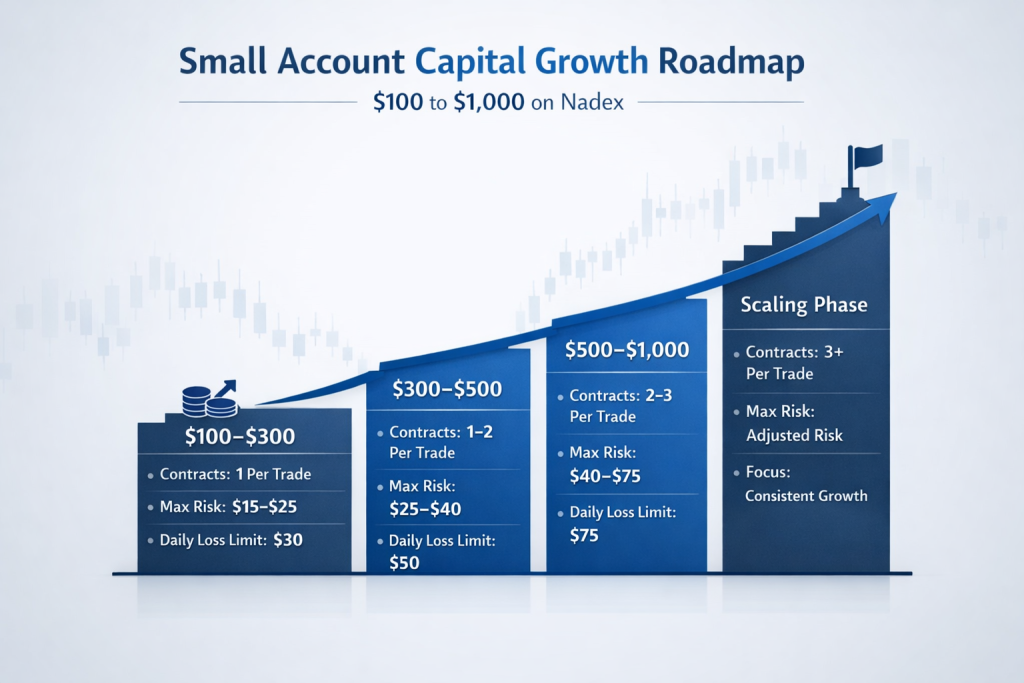
Instead of randomly increasing size, I created tiers.

Account SizeContracts Per TradeMax Risk Per TradeDaily Loss Limit
$100–$3001$15–$25$30
$300–$5001–2$25–$40$50
$500–$1,0002–3$40–$75$75

This structure prevented emotional scaling.

When I started with $250:

  • I only bought contracts priced between $20 and $40
  • I avoided $70+ contracts completely
  • I never risked more than 10–12% of account equity on a single trade

That is the backbone of my Nadex minimum capital strategy.
What I Actually Traded With $100–$500

I tested several markets:

  • Forex binaries
  • Stock index binaries
  • Call spreads
  • Knockouts

Here is what I discovered.

1. Forex Binaries Were the Most Capital Efficient

Pairs I focused on:

  • EUR/USD
  • GBP/USD
  • USD/JPY

These contracts often had pricing between $20–$50 depending on distance from strike.

That allowed:

  • Defined risk
  • Clear profit potential
  • Controlled exposure

When I tried trading index contracts like US 500, the pricing moved too aggressively for my small account tolerance.

2. Call Spreads Were Better After $400+

Below $300, spreads required too much buying power relative to my balance.

After crossing $400, I started experimenting with defined-range spreads. They provided smoother P&L swings compared to binaries.

If you are brand new to contract types, I broke down binaries vs spreads in detail in my guide on binary options trading basics (link to your internal article here).

My Exact Entry Framework (Documented From My Journal)

This is where most articles stay vague. I will not.

I traded only:

  • 5-minute and 15-minute expirations
  • During London and early New York session
  • On pullbacks within a clear trend

I used:

  • 20 EMA
  • 50 EMA
  • Previous session high/low

No complicated indicators.

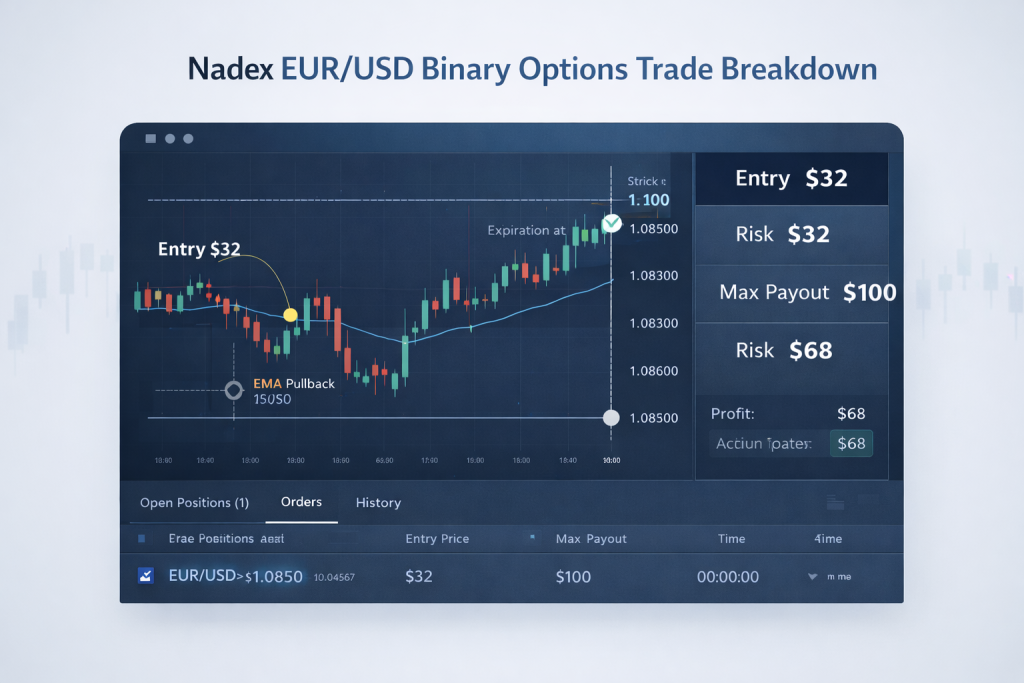
Example from my journal:

Date: Tuesday
Pair: EUR/USD
Trend: Bullish on 15-min
Setup: Pullback to 20 EMA
Contract bought at $32
Max risk: $32
Max payout: $68
Result: Expired at 100
Profit before fees: $68

After fees, net was slightly lower, but it was still a 2:1 reward relative to risk.

The key was patience. I sometimes waited 45 minutes for one setup.
The Compounding Myth (What Really Happens)

Many articles talk about compounding small accounts aggressively.

Here is what actually happened for me:

Week 1: $250 → $220
Week 2: $220 → $310
Week 3: $310 → $290
Week 4: $290 → $380

It was uneven. Slow. Frustrating.

But the drawdowns became smaller as my discipline improved.

The biggest turning point in my Nadex minimum capital strategy was adding a daily loss limit.

If I hit:

  • 2 full losses
  • Or 1 full loss + 1 half loss

I stopped trading for the day.

That single rule protected my capital more than any indicator.

Real Risk Management Rules I Follow

These are written exactly as they appear in my trading notebook:

  • Never average down
  • Never revenge trade
  • Stop after two losses
  • Reduce size after red day
  • Increase size only after 10% equity growth

Simple. But powerful.

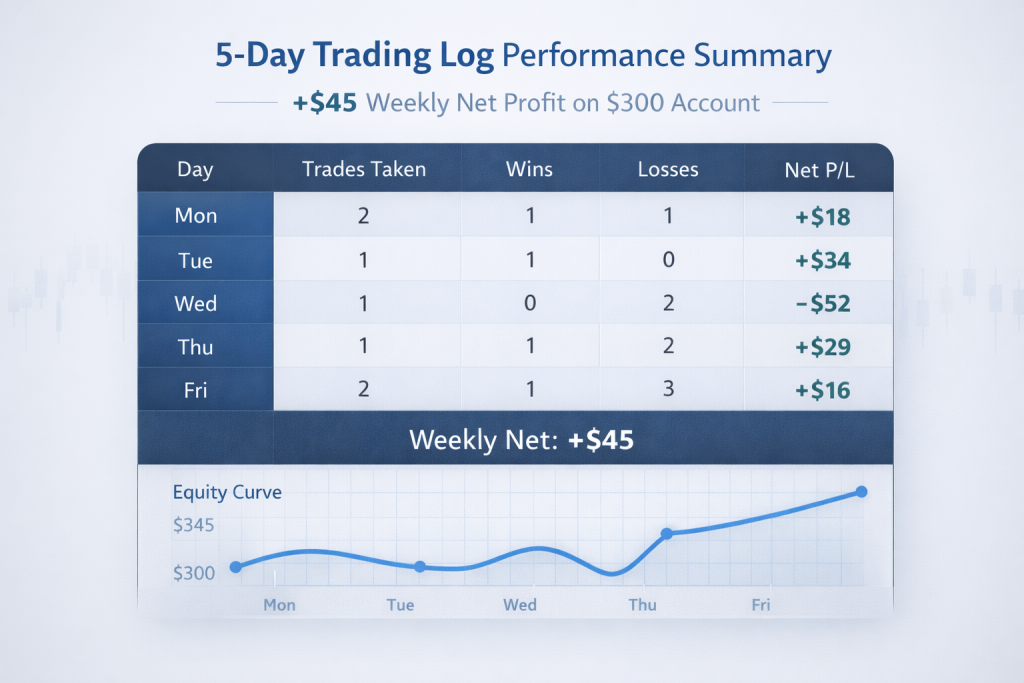
A Sample 5-Day Trading Log

Here is one actual sample week structure (simplified):

DayTrades TakenWinsLossesNet P/L
Mon211+$18
Tue110+$34
Wed202-$52
Thu110+$29
Fri211+$16

Weekly Net: +$45

On a $300 account, that is meaningful growth without reckless exposure.
The Psychological Shift Required

Small accounts magnify emotion.

When you lose $40 on a $250 account, it feels catastrophic.

What helped me:

  • Viewing trades as business expenses
  • Tracking stats instead of balance
  • Measuring execution quality, not outcome

I discuss more about trading psychology in my breakdown of how I handle losing streaks in my article on managing drawdowns in active trading (link internally).

What I Stopped Doing (Critical)

The growth in my Nadex minimum capital strategy came from elimination:

  • I stopped trading during news
  • I stopped trading low liquidity hours
  • I stopped trying to recover losses same day
  • I stopped increasing size after one big win

Most progress came from what I removed.

Scaling From $500 to $1,000

Once I crossed $500, I made two adjustments:

  1. Allowed 2-contract positions on A+ setups
  2. Slightly extended expiration to 15 minutes more often

That reduced noise and increased consistency.

Growth became steadier, not explosive.

If you are ready to start applying this structure step by step, you can open your Nadex account here and use the same capital tiers I described.

The Hard Truth About a $100 Account

Can you grow $100?

Yes.

Can you double it in a week consistently?

No.

With $100:

  • Trade 1 contract only
  • Look for $15–$25 risk entries
  • Accept slow growth

If you aim for 5%–10% weekly growth, you are already ahead of most retail traders.

I wish someone told me that earlier.

Where This Strategy Fits in a Bigger Plan

This Nadex minimum capital strategy is not a get-rich framework.

It is:

  • A discipline builder
  • A risk management training ground
  • A confidence stabilizer

If you eventually plan to scale into futures or options, this environment teaches defined risk thinking.

For readers comparing platforms, I also shared my experience reviewing different binary platforms in my in-depth platform comparison guide (link internally).

Final Thoughts: What Actually Makes It Work

After months of tracking data, I realized something simple.

Edge matters.
But risk control matters more.

With $100–$500:

  • Survival is priority
  • Consistency is secondary
  • Scaling is earned

My account did not grow because I found a magic setup.

It grew because I protected downside better than before.

If you want to implement this exact Nadex minimum capital strategy, start small, follow the capital tiers, and track every trade. Open your account here and treat it like a business from day one.

Trade small. Trade structured. Let growth come as a byproduct of discipline.
Nadex Binary Options vs Offshore Brokers: Risk, Regulation & Payout Comparison

I did not start my trading journey thinking about regulation.

I started thinking about money.

Like most retail traders, I was pulled in by screenshots of fast profits, social media claims of 80 percent returns in minutes, and the promise that binary options were simple. Just pick up or down. Fixed risk. Fixed reward.

What I did not understand at the time was that the real battle in Nadex Binary Options vs Offshore Brokers is not about payouts. It is about structure. It is about who holds your funds. It is about whether the platform sits on your side of the trade or matches you against other traders.

That realization took me years and several painful withdrawals to fully grasp.

If you are exploring regulated binary trading instead of offshore setups, you can open a Nadex demo or live account here and test the structure yourself before risking capital:
👉 https://static.olymptrade.com/lands/GA-OTPO-LPL45-07-01n/index.html?af_siteid=GA-OTPO-LPL45-07-01n&affiliate_id=2521424&lref=&lrefch=affiliate&pixel=1&subid1=&sub

This is not a promotional piece. It is my private trading notes turned into a structured comparison.

Let me walk you through what actually happened.

My First Experience with Offshore Binary Brokers

My first binary trade was with an offshore broker based in an island jurisdiction I had never heard of. The platform looked polished. The deposits were easy. The payouts were advertised at 85 percent.

I deposited $500.

My first trade was EUR/USD, 5-minute expiry, $100 position. I won. The return was $85.

The math looked simple:

  • Risk: $100
  • Potential Profit: $85
  • Total Returned if Win: $185

It felt clean.

But then I noticed something strange.

When price was extremely close to my entry at expiry, the result sometimes flipped against me. On another trade, my price chart froze for a few seconds. I dismissed it as internet lag.

Then I tried to withdraw $1,200 after a strong week.

That is when the emails started.

Additional verification. Bonus volume requirements. Trading turnover conditions. Compliance review.

The issue with most discussions about Nadex Binary Options vs Offshore Brokers is that they focus only on payout percentage. They rarely talk about withdrawal friction.

That friction was my first real lesson.

Discovering Nadex

I came across Nadex while searching for regulated alternatives. What caught my attention was not payout percentages. It was one line:

“US regulated exchange.”

That was new to me.

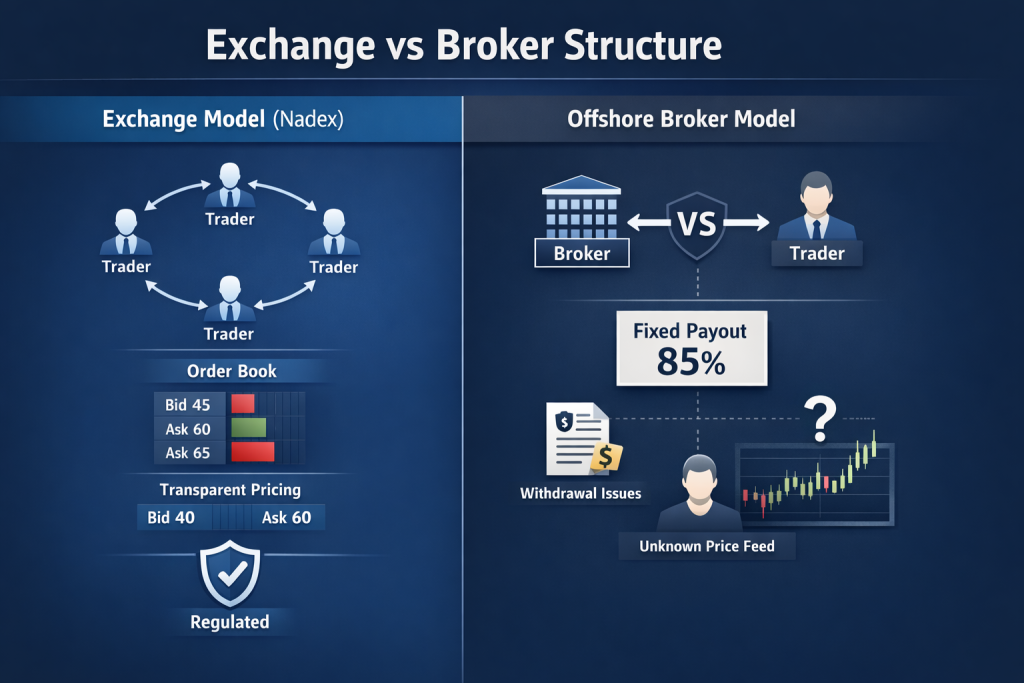
Unlike offshore brokers, Nadex operates as an exchange. Traders trade against each other. The platform does not take the opposite side of your trade.

That structural difference changes everything.

In the Nadex Binary Options vs Offshore Brokers debate, this is the core distinction:

FeatureNadexOffshore Broker
StructureExchangeBroker
CounterpartyOther tradersThe broker
RegulationUS regulatedOffshore jurisdictions
PricingTransparent bid/askFixed payout
Early ExitYesUsually no

At first, Nadex felt more complicated. Instead of “invest $100 to make $85,” I saw contracts priced between 0 and 100.

That confused me.

Then I realized something important.

On Nadex, the price itself represents probability.

Understanding Nadex Contract Pricing

A Nadex binary contract settles at 0 or 100.

If I buy at 35:

  • My maximum risk = $35
  • My maximum reward = $65

If I sell at 65:

  • My maximum risk = $35
  • My maximum reward = $65

This is very different from offshore fixed payouts.

In Nadex Binary Options vs Offshore Brokers comparisons, most articles stop here. But what they do not explain is how pricing impacts trade management.

With offshore brokers:

  • You cannot exit early (in most cases).
  • You are locked until expiry.
  • The broker decides if you win or lose based on their price feed.

With Nadex:

  • You can exit anytime.
  • You can reduce loss before expiry.
  • You can lock partial profit.

That flexibility saved me during a volatile NFP release.

The Trade That Changed My View

It was a Friday. Non-Farm Payrolls.

I bought a Nadex binary on the S&P 500 at 42, expecting bullish continuation.

Price spiked in my favor quickly. The contract moved to 68.

Instead of waiting for full settlement at 100, I exited at 67.

Profit calculation:

  • Entry: 42
  • Exit: 67
  • Profit: 25 points

That is $25 per contract.

On an offshore platform, I would have had to wait. If price reversed by expiry, I would have lost the entire stake.

This is one of the biggest hidden realities in Nadex Binary Options vs Offshore Brokers discussions. Trade management matters more than payout percentage.

If you want to experience that contract flexibility yourself, you can open a Nadex account here and test it on demo first.

Risk Comparison: What I Learned the Hard Way

When I traded offshore binaries, my risk was binary in the worst sense.

  • Win full payout
  • Lose entire stake

There was no scaling out.
No partial exit.
No limit orders.

With Nadex, risk is defined upfront and capped. But more importantly, it is adjustable.

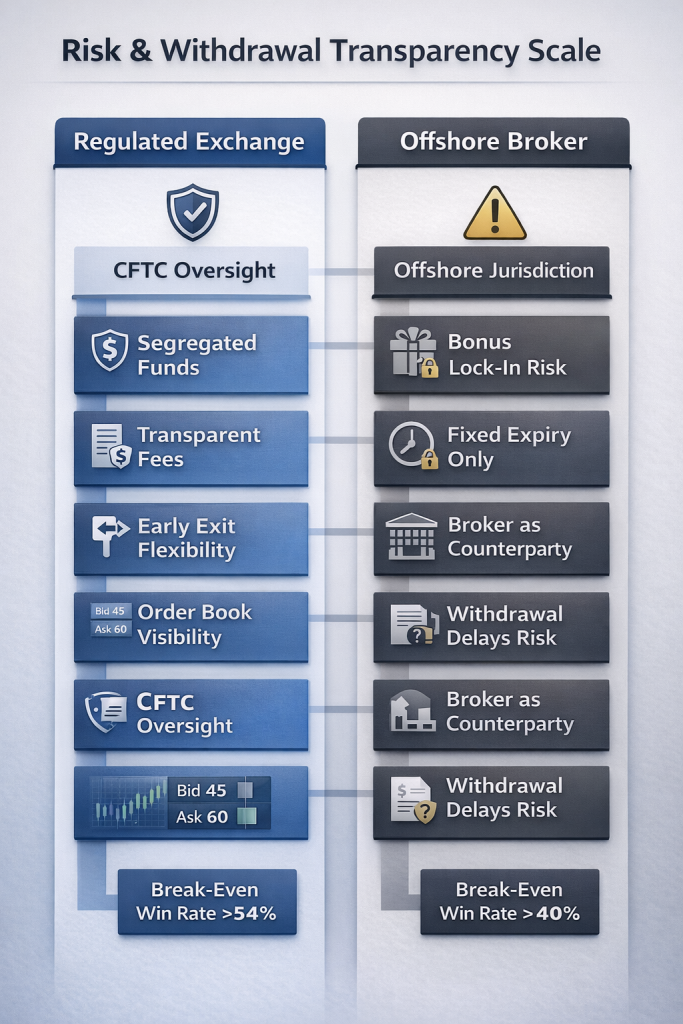
Offshore Risk Profile

  • Broker controls price feed.
  • Slippage at expiry can flip outcomes.
  • Bonuses restrict withdrawals.
  • Capital often held in segregated but loosely supervised accounts.

Nadex Risk Profile

  • Exchange-based matching.
  • Clear maximum risk per contract.
  • Transparent fees.
  • Regulated oversight.

This regulatory layer matters.

Nadex is regulated by the Commodity Futures Trading Commission.

That does not guarantee profits. It does guarantee oversight.

In the Nadex Binary Options vs Offshore Brokers comparison, this is not a minor detail. It is foundational.

Payout Comparison: The Illusion of 90 Percent Returns

Offshore brokers advertise:

“Earn up to 90 percent in 60 seconds.”

That sounds better than buying at 40 and earning 60 on Nadex.

But here is the math I eventually calculated.

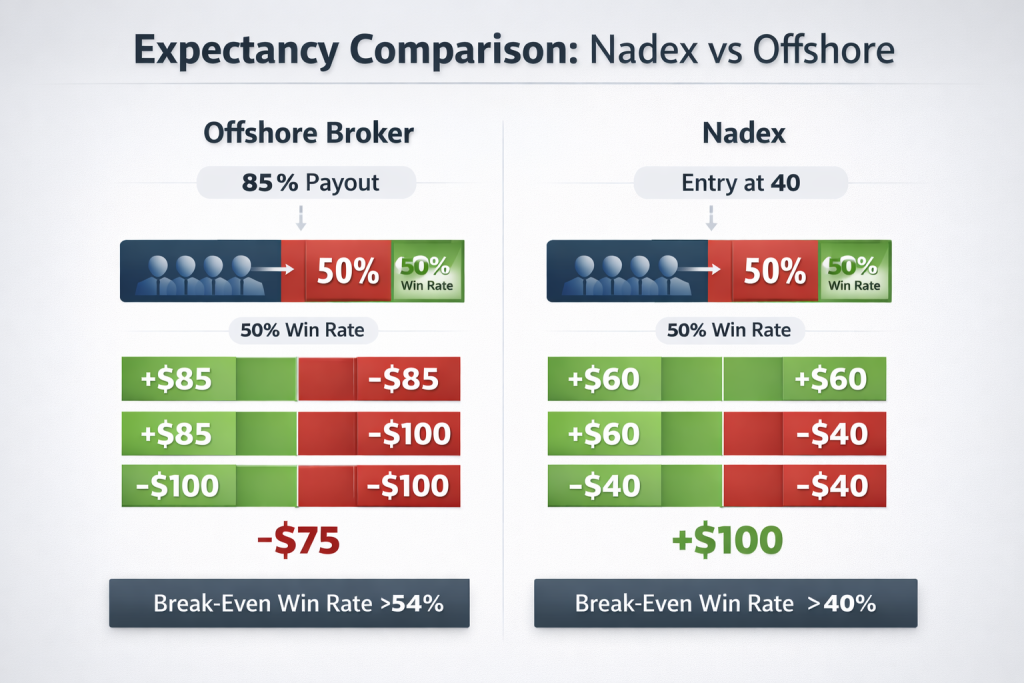
Let us say an offshore broker offers 85 percent payout.

If you win 50 percent of trades:

  • 10 trades
  • 5 wins = +$425
  • 5 losses = -$500
  • Net = -$75

You need a win rate above 54 percent just to break even.

On Nadex, because contracts are priced by probability, break-even math depends on entry price.

If I consistently buy contracts around 40, I need to win just over 40 percent of the time to break even.

That was eye-opening.

The Nadex Binary Options vs Offshore Brokers debate often ignores expectancy math. But expectancy is what determines survival.

Withdrawal Experience: Reality Check

My worst offshore experience was a $3,800 withdrawal delay.

No scam language. No threats. Just silence.

Eventually the funds arrived, but the psychological damage was done. Every trade felt like I was gambling against the house.

With Nadex, withdrawals felt procedural. Slower than crypto brokers, but predictable.

That predictability matters.

If you are serious about building a system, you cannot operate under constant counterparty anxiety.

Trade Transparency and Order Book

Another difference rarely discussed in Nadex Binary Options vs Offshore Brokers comparisons is the order book.

On Nadex, I can see:

  • Bid and ask prices.
  • Market depth.
  • Where liquidity sits.

Offshore platforms show a simplified chart with no true depth visibility.

This is the difference between trading in a marketplace and betting in a closed room.

Fees: The Hidden Variable

Offshore brokers advertise “zero commission.”

That sounds attractive.

But their spread and payout structure embed their profit.

Nadex charges:

  • A small entry fee.
  • A settlement fee (capped).

At first I disliked fees.

Then I realized something important. Transparent fees are usually better than hidden structural edge.

Strategy Adaptation: How My Approach Changed

With offshore binaries, my strategy was momentum-based scalping.

With Nadex, I shifted toward:

  • Selling overpriced contracts.
  • Buying undervalued probabilities.
  • Exiting early when delta shifted.

This turned binary options from a coin-flip style system into something closer to probability trading.

If you are transitioning from offshore platforms, you may also want to read my breakdown on position sizing psychology and risk stacking, which complements this comparison and shows how contract pricing changes your mindset.

I also covered expectancy modeling in my guide to structured risk management, which explains how probability-based entries outperform fixed payout chasing.

Psychological Difference

This was the biggest shift.

With offshore brokers, I felt like I was trying to beat the platform.

With Nadex, I felt like I was trading other participants.

That psychological framing changed my discipline.

Losses felt market-driven.
Wins felt earned.

In Nadex Binary Options vs Offshore Brokers comparisons, this emotional component is rarely discussed. But it affects long-term consistency.

Who Should Consider Offshore Brokers?

I will be honest.

Some traders prefer offshore platforms because:

  • Simpler interface.
  • Faster onboarding.
  • Crypto deposits.
  • Higher advertised payouts.

If someone is purely speculating short term and understands counterparty risk, that is a choice.

But they must understand:

You are trading against the house.

Who Should Consider Nadex?

Based on my experience, Nadex is better suited for:

  • Traders who value regulation.
  • Those who want capped risk.
  • Traders who want early exit flexibility.
  • Those building long-term models.

If you want to test the exchange structure and see how contracts are priced in real time, you can open a Nadex account here.

Start with demo. Study contract pricing. Watch how probabilities shift.

Final Thoughts: Nadex Binary Options vs Offshore Brokers

After years of switching back and forth, here is my honest conclusion.

Offshore brokers optimize for speed and marketing appeal.

Nadex optimizes for structure and transparency.

If you are chasing fast payouts, offshore platforms will look attractive.

If you are building a repeatable system, the exchange model makes more sense.

The Nadex Binary Options vs Offshore Brokers comparison is not about which one pays more on a single trade. It is about which one gives you a sustainable framework.

My early years were driven by payout percentages.

My later years were driven by expectancy, risk caps, and regulatory oversight.

That shift made the difference.

If you are ready to move from fixed payout betting toward exchange-based binary trading, open your Nadex account here and explore the platform with a structured mindset.

Trade small. Document everything. Focus on math, not marketing.

That is the lesson I wish I had learned sooner.

Best Short-Term Strategies for ExpertOption (5 Proven Methods)

I still remember my first week trading on ExpertOption. I had read the guides, watched the promotional videos, and convinced myself that short-term trading was about speed.

It was not.

It was about control under pressure.

Before I risked serious money, I studied the platform mechanics carefully. I even documented my findings in my detailed ExpertOption broker review at a glance where I break down payouts, assets, and execution quality. Understanding the platform itself was step one. Strategy came second.

If you are just getting started and want to apply these methods properly, you can open a live trading account here and begin small while testing each setup with strict risk control.

Everything I share below comes from real sessions, logged trades, screenshots, and performance tracking. These are the best short-term strategies for ExpertOption that survived real market conditions, not hindsight examples.

Why Most Short-Term Traders Fail on ExpertOption

The content gap I noticed across most Google results is simple. They explain indicators. They do not explain execution context.

Short-term trading compresses time. A five-minute mistake happens in five seconds.

Here are the mistakes I made early:

MistakeWhat HappenedLesson
Entering on first touch of levelFake breakouts trapped meWait for candle confirmation
Blind RSI reversalsCounter-trend losses piled upAlign with higher timeframe
Overtrading volatile sessionsEmotional decisionsCap daily trades

I also realized many traders never verify platform credibility. That is why I wrote about ExpertOption safety and whether it is legit or a scam, supported with personal experience and research.

Trust and structure matter before strategy.

Now let me share the five methods that changed my consistency.

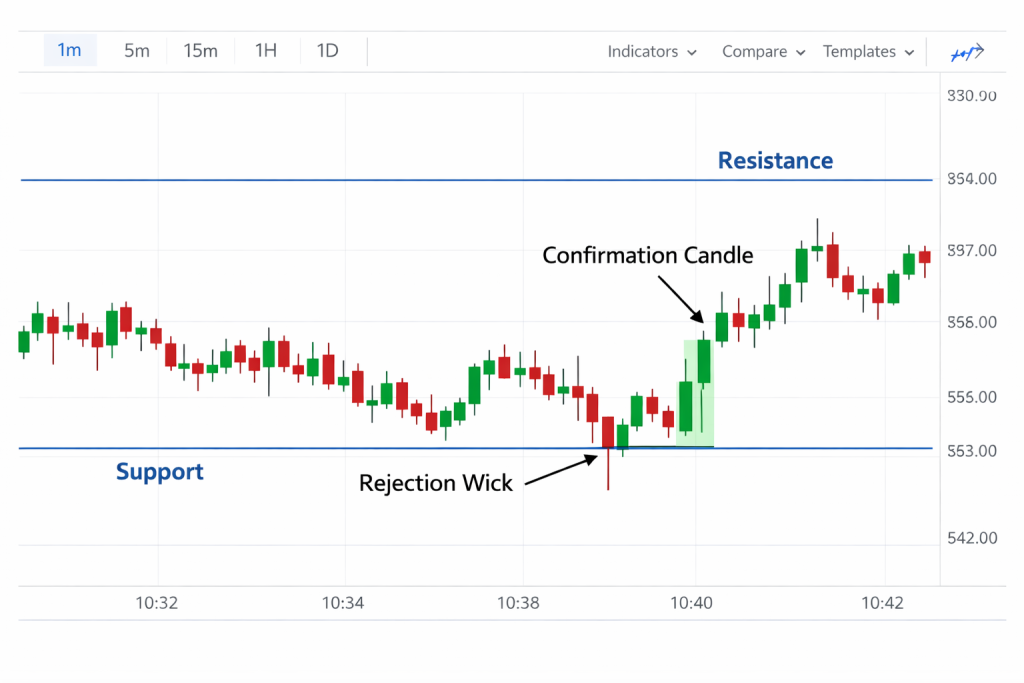
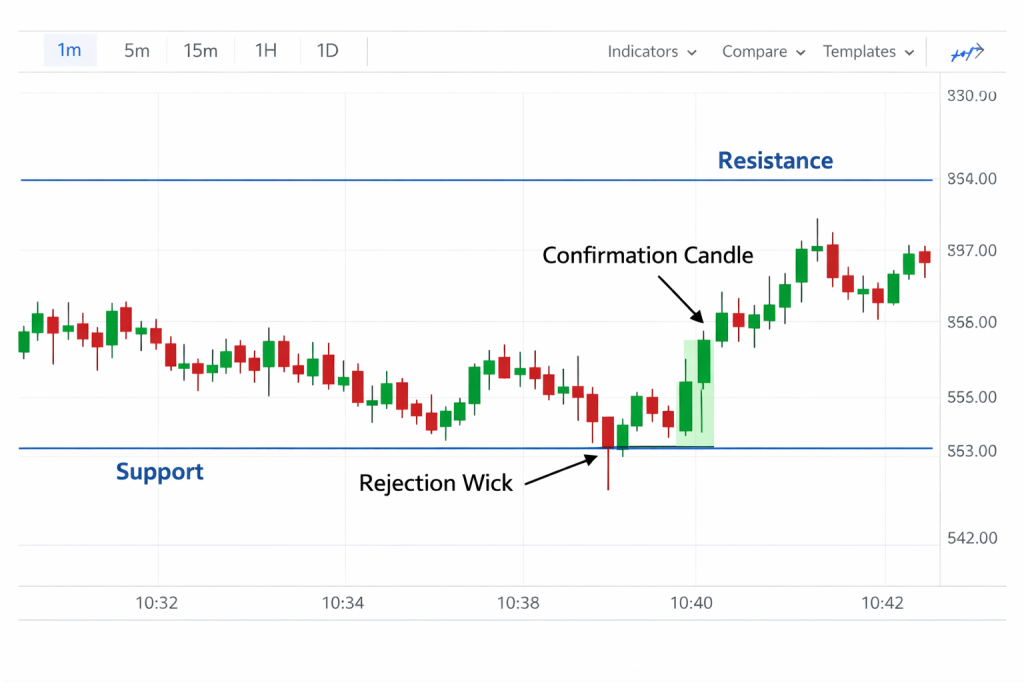
1. 1-Minute Support and Resistance Rejection Strategy

This was my foundation. It is simple but powerful when executed correctly.

I mark:

  • Session highs and lows
  • Intraday consolidation zones
  • Repeated reaction levels

Then I wait.

Entry Rules I Follow

CALL trade:

  • Price touches tested support
  • Strong lower wick rejection
  • Confirmation candle closes bullish
  • Expiry 1–3 minutes

PUT trade:

  • Price touches resistance
  • Upper wick rejection
  • Bearish confirmation candle
  • Expiry 1–3 minutes

The key difference between losing and winning here was patience. I stopped entering at first touch.

My win rate improved from 48 percent to 61 percent once I required candle confirmation.

If you want a more detailed breakdown of fast executions specifically tailored to 60-second charts, I expanded this structure in my full guide to the ExpertOption 1-minute strategy.

This remains one of the most reliable short-term strategies for ExpertOption in my trade log.

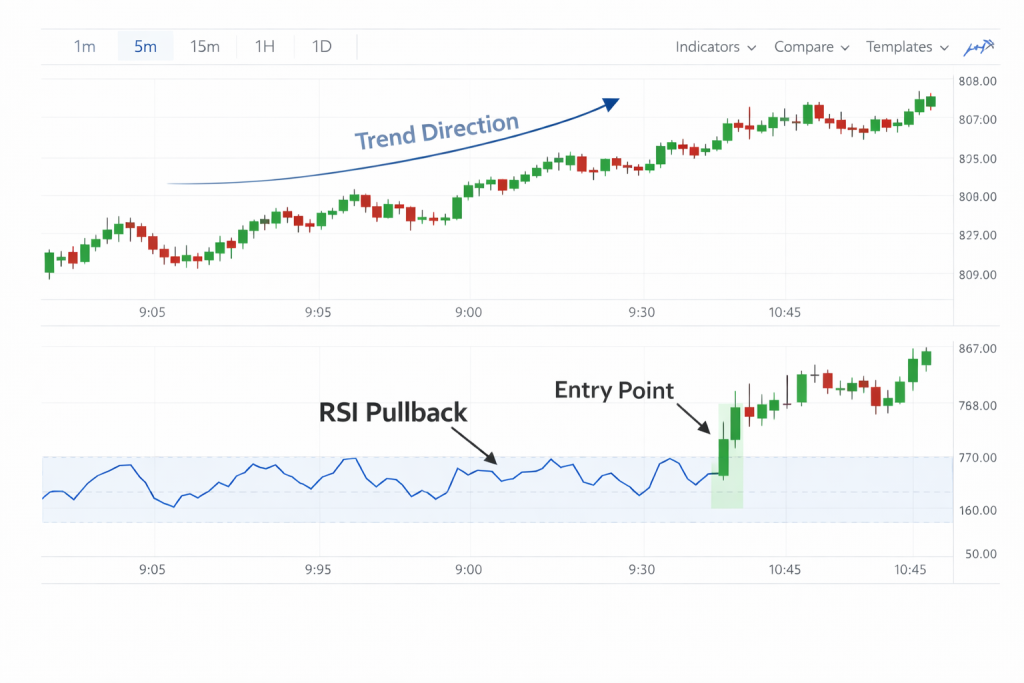
2. RSI Pullback Within Trend Strategy

I used to treat RSI as a reversal tool. Oversold meant buy. Overbought meant sell. That approach drained my account.

The turning point came when I combined RSI with trend direction.

My Process

  1. Identify 5-minute trend bias
  2. Drop to 1-minute chart
  3. Wait for RSI pullback inside trend
  4. Enter in direction of main trend

For example:

  • 5-minute chart shows higher highs
  • 1-minute RSI dips below 40
  • Bullish candle confirms
  • I enter CALL with 2-minute expiry

Once I started tracking data:

Setup TypeWin Rate
Counter-trend RSI44%
Trend-aligned RSI63%

That shift changed everything.

I also refined entries by studying price action deeper. My breakdown of essential candlestick patterns every trader should know helped me filter weak signals from strong continuation candles.

Most articles mention RSI. Few explain contextual filtering. That filter made this one of my core short-term strategies for ExpertOption.

3. 3-Candle Momentum Breakout Strategy

This method only works during active sessions.

I look for:

  • Three strong consecutive candles
  • Minimal upper or lower wicks
  • Clear break of micro consolidation
  • No nearby resistance or support

Expiry: 1 minute.

Session Filter Matters

Market SessionWin Rate
London64%
New York62%
Asian47%

The Asian session killed this strategy. Liquidity was too thin.

Once I limited trades to London and New York, performance stabilized.

This is more aggressive than support/resistance trading. So I reduce position size slightly.

If you are unsure whether to trade via browser or app during volatile sessions, I compared the execution experience in my Web vs Mobile vs Desktop app comparison where I documented real latency differences.

Execution speed matters more than most traders admit.

Midway through my journey, I realized discipline matters more than strategy. If you want to apply these methods seriously, register your ExpertOption account here and start with small controlled positions instead of emotional sizing:
https://r.expertoption-track.com/?prefid=1014997001&p=regform

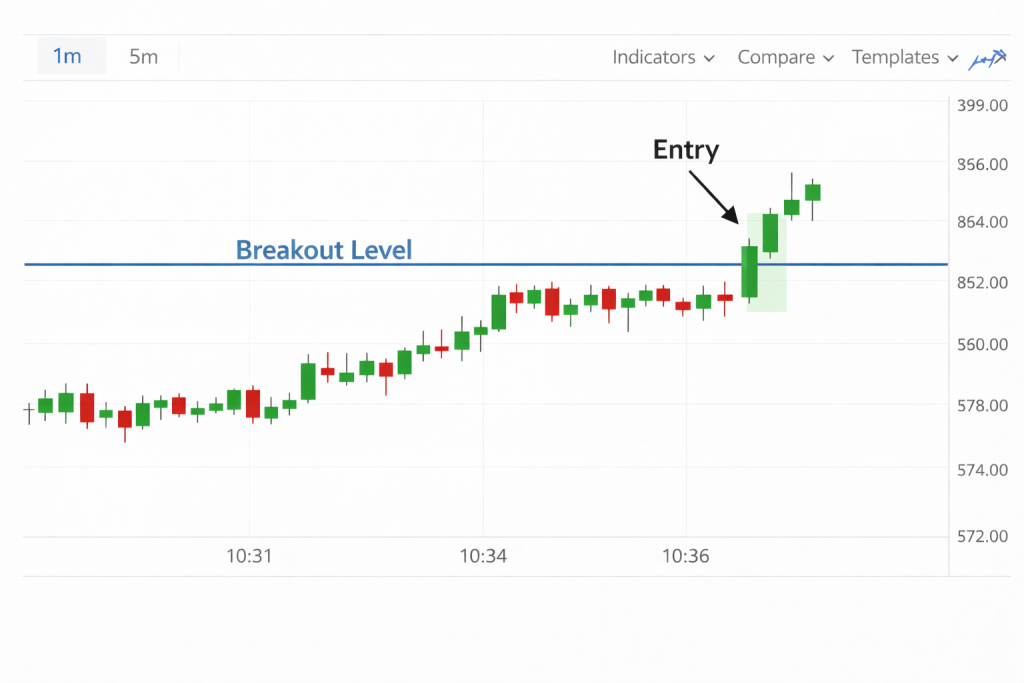
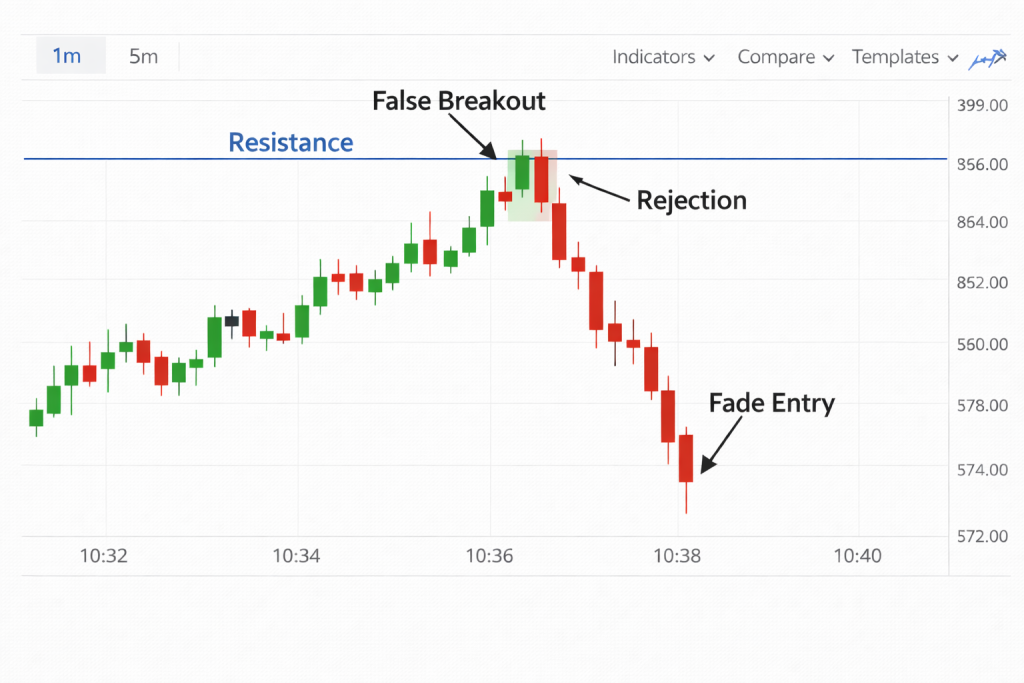
4. False Breakout Trap Strategy

Breakouts are seductive. But short-term charts are full of traps.

I began marking obvious breakout levels. Instead of chasing, I waited for failure.

Setup

  1. Price breaks above resistance
  2. Immediately closes back below
  3. Bearish engulfing candle forms
  4. Enter PUT

Or inverse for support.

After tracking 100 trades:

Entry TypeWin Rate
Breakout Chase49%
False Break Fade66%

The edge was fading emotional retail entries.

This method requires strong pattern recognition. Studying structured candlestick behavior significantly improved my timing accuracy.

Among all the short-term strategies for ExpertOption, this one required the most emotional control.

5. Session Open Volatility Expansion Strategy

The first 30 minutes of London session often provide structured expansion.

My checklist:

  • Mark first 5-minute range
  • Wait for strong breakout candle
  • Enter continuation
  • Maximum 3 trades
  • Stop after 2 losses

No revenge trading.

Many traders ignore session timing. That is why their results feel random.

If you primarily trade on your phone, I shared my full experience in my ExpertOption mobile app review for iOS and Android, where I documented real trading sessions directly from mobile.

Execution comfort affects psychology.

Risk Management Framework I Follow

No strategy saved me until I standardized risk.

My structure:

  • Risk 1–2 percent per trade
  • Maximum 5 percent daily loss
  • Maximum 10 trades per session
  • Mandatory break after 3 consecutive losses

My capital growth was not smooth.

MonthStartEndNote
1$500$470Overtrading
2$470$620Strict discipline
3$620$890Strategy filtering

Progress came from filtering, not forcing trades.

Psychological Lessons That Changed Everything

Short-term trading amplifies emotion.

What changed for me:

  • I stopped expecting daily profits
  • I accepted losses as operational cost
  • I logged every trade
  • I stopped increasing size after wins

I also explored copy trading to observe other structured traders. In my guide to ExpertOption copy trading, I break down how I analyzed signal providers without blindly following them.

Transparency matters. That is why I even published my real ExpertOption withdrawal proof to demonstrate actual payout experiences instead of just theory.

Short-term strategies for ExpertOption only work if you trust the process and the platform.

Demo Before Live

Before scaling, I recommend structured demo testing. I documented my full demo workflow in my complete ExpertOption demo account guide.

Testing each strategy over 50 trades gave me statistical confidence.

That confidence reduced emotional mistakes in live markets.

Understanding Bonuses Before You Trade

Early in my journey, I misunderstood bonus conditions. That created withdrawal limitations.

If you are considering deposit bonuses, read my breakdown of ExpertOption bonuses explained and hidden terms revealed before accepting anything.

Clarity prevents future frustration.

Why These Are the Best Short-Term Strategies for ExpertOption

These five survived because they share:

  1. Clear entry logic
  2. Defined expiry rules
  3. Session filtering
  4. Data validation
  5. Strict capital control

The biggest gap in online content is real performance fluctuation. My win rate fluctuates between 58 and 65 percent depending on market conditions.

There is no magic formula.

There is structured probability.

The best short-term strategies for ExpertOption are not about finding the perfect indicator. They are about repeatable frameworks.

My Daily Routine Now

Morning:

  • Check economic calendar
  • Mark levels
  • Define session plan

During session:

  • Wait for setup
  • Execute
  • Log instantly

After session:

  • Review screenshots
  • Update statistics
  • Journal emotional control

This routine turned chaos into structure.

If you are ready to implement these methods with discipline, open your ExpertOption account here and start small while tracking your first 50 trades per strategy.

Short-term strategies for ExpertOption only become powerful when documented, tested, and executed with restraint.

It took me years to understand that consistency comes from control, not speed.

And once I understood that, my trading finally stabilized.